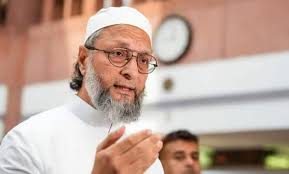

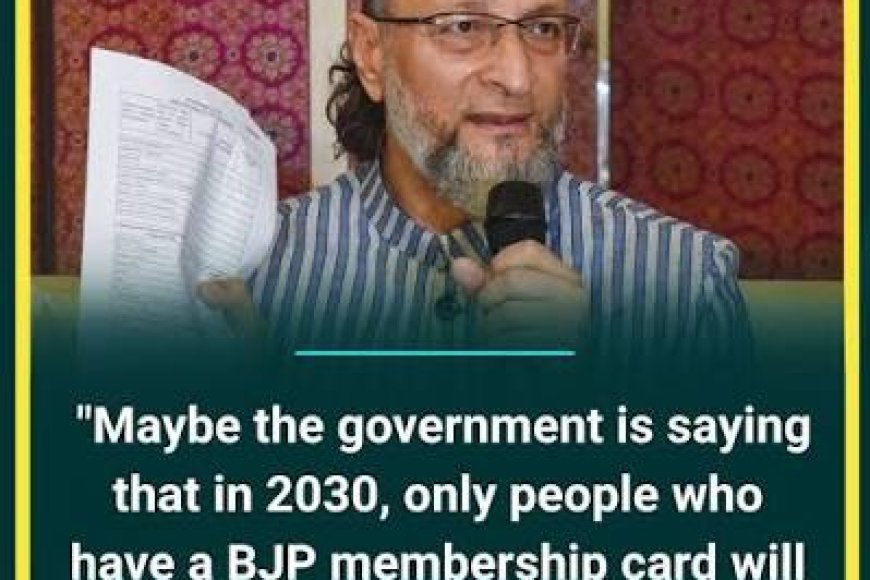
Hyderabad : NRC debate returns to political spotlight ahead of UP polls as Owaisi raises fresh questions. Fresh political debate over the National Register of Citizens (NRC) has emerged months ahead of the Uttar Pradesh Assembly elections after AIMIM chief Asaduddin Owaisi claimed that the Centre could move towards implementing the exercise.
Speaking at a meeting of lawyers in Telangana, Owaisi said Union Home Minister Amit Shah "does not speak casually" and suggested that recent developments indicated the possibility of an NRC in the future.
In today's episode of DNA, Rahul Sinha, Managing Editor of Zee News, conducted a detailed analysis of Owaisi's remarks, the current legal status of the NRC, and whether there is any basis for the claim that a nationwide exercise is imminent.
Owaisi made the remarks while discussing the ongoing Special Intensive Revision (SIR) process in Telangana. He urged the state government to issue Permanent Residence Certificates so that eligible residents are not excluded during the exercise.
However, he also linked the issue to the possibility of a nationwide NRC, a claim that has once again brought the subject into political focus.
The NRC, or National Register of Citizens, is an official register intended to identify Indian citizens while excluding illegal immigrants.
It was first prepared after the 1951 Census, but only for Assam. The exercise was undertaken there because of large-scale illegal migration from the then East Pakistan.
In 2003, provisions were introduced to enable the preparation of a nationwide NRC. However, such an exercise has never been carried out across the country.
Following directions from the Supreme Court in 2013, Assam's NRC was updated, and the final list published in 2019 excluded around 1.9 million applicants out of nearly 33 million.
Even so, the list has not been finally notified by the Registrar General of India, and the matter remains pending before the Supreme Court.
As matters stand, Assam remains the only state where the NRC process has been undertaken, and that process itself has not reached its legal conclusion. There is currently no nationwide NRC in force.
The Bharatiya Janata Party's position has also changed over time. Its 2019 Lok Sabha election manifesto stated that, after completing the NRC in Assam, the party would actively consider introducing it in phases across the rest of the country.
However, the NRC found no mention in the BJP's 2024 election manifesto. While several BJP leaders have, in the past, spoken in favour of identifying and removing illegal immigrants, the Union government has repeatedly maintained that no decision has been taken on implementing a nationwide NRC.
Despite the government's position, the NRC has remained a politically sensitive issue.
During protests against the Citizenship Amendment Act (CAA) in 2019, opposition parties and several organisations linked the CAA with the NRC, arguing that the two measures together could affect the citizenship of Indian Muslims.
The Centre consistently rejected that claim, stating that the CAA is a law intended to grant citizenship to specified persecuted minorities from neighbouring countries and not to take citizenship away from existing Indian citizens.
Nevertheless, widespread protests, road blockades and violence were witnessed in several parts of the country, including the 2020 riots in Delhi.
Owaisi had also linked the CAA with the NRC during those protests. This time, however, he has connected the possibility of an NRC with a high-level committee on demographic changes constituted by the Ministry of Home Affairs on 26 May.
According to the government's notification, the committee has been tasked with examining demographic changes and identifying illegal immigrants. It has not been assigned the responsibility of preparing a National Register of Citizens.
The committee is expected to submit its report next year, and no decision has yet been announced regarding any further action on its recommendations.
Although Owaisi's remarks were made in Telangana, they are likely to resonate in Uttar Pradesh, which has the country's largest Muslim population and is due to hold Assembly elections early next year.
With no recent announcement from the Centre on a nationwide NRC, the renewed political debate has also raised questions over whether the issue is being brought back into focus ahead of a crucial electoral contest.