
Chikkamagaluru: At a time when attempts to create divisions in society in the name of religion and caste continue to surface, a Muslim woman in NR Pura town has emerged as an example of communal harmony by leading a Ganesha festival committee for the past 18 years.
“I consider myself an Indian first. Religion and caste come later. She ensures that the premises are cleaned with cow dung and decorated with colourful rangoli.
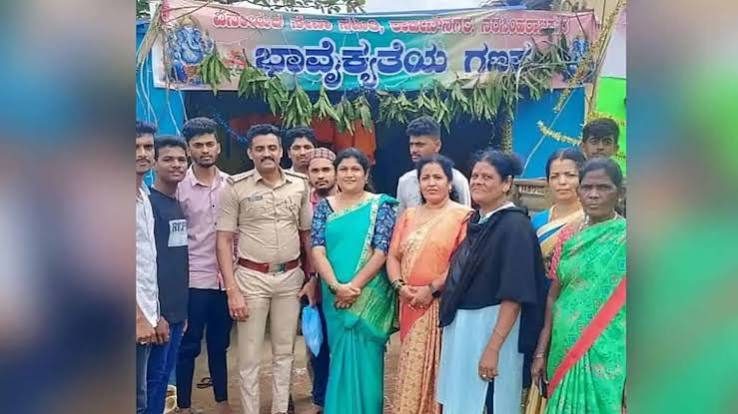
Group of people, including a woman in a blue saree, at Ganesha festival celebration in Chikkamagaluru.
Jubeda, a former president of NR Pura Town Panchayat, serves as the president of the Rajivnagar Sri Vinayaka Seva Samiti. Every year, the committee installs a Ganesha idol and observes the festival for three days.
What makes Jubeda’s association with the celebrations unusual is the active role she takes in organising the religious programmes.
As the committee president, she oversees various rituals, including Ganesha homa and Satyanarayana puja, and takes responsibility for ensuring that the celebrations are conducted according to tradition.
She also serves as secretary of the Karthika Deepotsava committee and helps organise the annual Deepotsava at the Nagarabana near Ashwathkatte in the town.
During Ganesha festival preparations, Jubeda encourages women in the locality to participate in cleaning the area surrounding the pandal.
She ensures that the premises are cleaned with cow dung and decorated with colourful rangoli.
Local youngsters extend their support in constructing the Ganesha pandal. From the installation of the idol to its immersion, Jubeda personally oversees the arrangements and participates in the religious rituals. She also visits other Ganesha pandals in the town, offers prayers and extends assistance wherever required.
Her participation in festivals is not limited to Ganesha celebrations. She has for years maintained close ties with Hindu families in the locality and visits their homes during festivals, accepting prasada and joining in their celebrations.
“I consider myself an Indian first. Religion and caste come later. While remaining committed to my own faith, I respect all religions. For me, humanity is more important than religion,” Jubeda said.
She believes that participation in each other’s festivals strengthens social bonds. “When we participate in Hindu festivals, they also join us during Muslim festivals. People belonging to different faiths live here with mutual respect and harmony,” she said.
Residents have also spoken highly of her efforts to support women from economically weaker sections.
Shanthamma, a resident of the Housing Board area, described Jubeda as a “Dharma Devathe” for women facing difficulties. She said Jubeda provides financial assistance to poor Hindu women during festivals and extends support to disadvantaged women.
Jubeda also runs a tailoring training centre aimed at helping poor and underprivileged women acquire skills and become financially independent, Shanthamma said.
S.E. Parameshwar, president of the Netaji Yuvaka Sangha Ganapati Seva Samiti, said Jubeda had maintained cordial relations with people across communities and remained involved in their happiness as well as difficulties.
“During Deepavali, Jubeda decorates her house with lights. Those trying to sow hatred in society in the name of religion should learn from her life,” he said.
For nearly two decades, Jubeda’s involvement in Ganesha celebrations has offered a different picture of religious participation, with residents pointing to her role as an example of coexistence, mutual respect and shared community life.
Her continued leadership of a Hindu festival committee as a Muslim woman has become a local symbol of the idea.