
Washington: Chinese President Xi Jinping's upcoming state visit to the United States is poised to address critical economic and trade issues, including the burgeoning field of artificial intelligence and the contentious new US sanctions targeting nations that purchase Russian oil and gas.
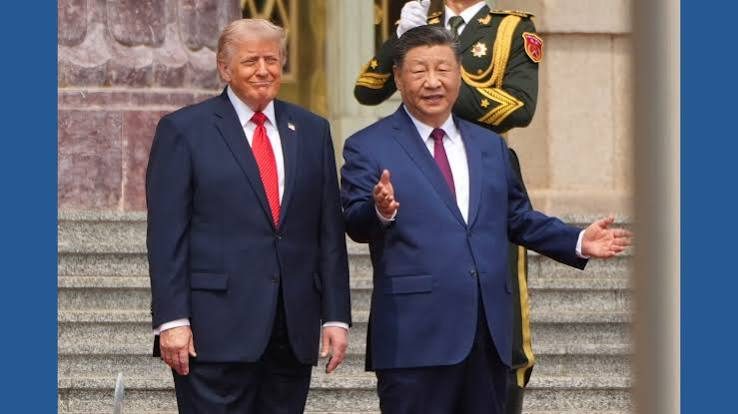
Chinese President Xi Jinping will undertake a state visit to the US from September 23-25 for summit talks with President Donald Trump.
Key discussions will focus on economic and trade issues, including artificial intelligence (AI), and the implications of new US sanctions on Russian energy buyers.
High-level officials from both nations have already held 'candid, in-depth and constructive' talks on these economic and trade matters.
The visit gains significance following Trump's signing of a law authorising tariffs on countries purchasing Russian oil and gas, and his unveiling of a new 'AI Force'.
China has rejected US tariffs on Russian energy purchases, asserting that normal trade cooperation should not be subject to third-party interference.
Chinese President Xi Jinping will pay a state visit to the United States from September 23 to 25 at the invitation of United States President Donald Trump, a Chinese Foreign Ministry spokesperson announced on Monday.
Xi is scheduled to arrive in Washington on September 23 and hold summit talks with Trump, the official said.
Pre-Summit Discussions and Key Agendas
Ahead of the visit, top officials from the US and China held 'candid, in-depth and constructive' talks on economic and trade issues, including AI.
Top officials who led the Sunday talks in New York included Chinese Vice Premier He Lifeng, US Treasury Secretary Scott Bessent and US Trade Representative Jamieson Greer, China's state-run Xinhua news agency reported.
Guided by the important consensus reached by the heads of state of the two countries, they have engaged in exchanges on important economic and trade issues of common concern, as well as the implementation of consensus reached in previous talks, by upholding the principles of mutual respect, peaceful coexistence and win-win cooperation, the report said.
Xinhua said Bessent and the vice premier talked about issues relating to AI, without mentioning specifics, and also had 'candid, in-depth and constructive discussions' on key economic and trade issues.
They also held dialogues on AI-related issues, it said. Trump plans to accord a rare airport reception to Xi by personally receiving him on the tarmac at Joint Base Andrews, the Hong Kong-based South China Morning Post earlier reported.
The two leaders last met in Beijing in May during Trump's visit, when they held talks aimed at improving ties between the world's two largest economies.
Sanctions and Trade Tensions
The upcoming talks have assumed more significance against the immediate backdrop of Trump signing a new sanctions law that authorises tariffs of up to 100 per cent on countries buying Russian oil and gas, including China and India.
Trump has also unveiled a new 'AI Force' in a potential escalation of the high-stakes technology race between the rival powers.
In a social media post on Saturday, Trump said attempts at the 'decimation, or destruction, of AI' were among the many hoaxes generated by what he called the Radical Left Democrats.
Trump has also signed the Lindsey O Graham Sanctioning Russia and Iran Act of 2026 into law, which authorises expanded sanctions and tariffs targeting Russia and countries that buy its energy exports.
China has rejected US attempts to impose tariffs over its purchases of Russian oil and gas, saying normal trade cooperation between countries should not be subject to interference by third parties.
China engages in normal economic and trade cooperation with other countries based on equality and mutual benefit, Guo Jiakun told reporters last week.
China opposes long-arm jurisdiction and unilateral sanctions that have no basis in international law and lack a UN Security Council mandate, he said.
Future of US-China Economic Relations
Despite the tariff threat, Washington, DC and Beijing are also negotiating a reciprocal tariff reduction framework covering products worth $30 billion from each side, China's commerce ministry said.
The consultations aim to reach a reciprocal tariff reduction arrangement at the earliest possible date, ministry spokesperson Huang Ling said.
Ahead of the summit, Chinese Foreign Minister Wang Yi and US Secretary of State Marco Rubio also held a telephone conversation on September 17, focusing on high-level exchanges between the two countries.