
New Delhi : Amit Malviya paid the price because he committed the cardinal mistake of himself 'becoming' the BJP's IT Cell and its social media.
Malviya's removal contains a message to others -- never try to become bigger than the job that has been assigned.
Nitin Nabin announced BJP's national office bearers after eight months, raising questions about his autonomy and decision-making authority.
The BJP's organisational evolution has reduced internal accountability, with major decisions increasingly concentrated among the party's top leadership.
Smriti Irani's return offers political rehabilitation, although her role remains carefully circumscribed within the party's organisational structure.
Piyush Goyal's return as treasurer fuels speculation about a possible Cabinet reshuffle and the party's one-person-one-post principle.
Bharatiya Janata Party President Nitin Nabin on Monday, August 17, announced the appointment of his 'team' of national office bearers, seven months and three days into office.
A month or so earlier, he slid into the top chamber of the party hierarchy when he was named as the next party president and in the interim, before he formally took charge, began 'functioning' as working president, although no such post exists in the party constitution.
During that period he held a non-existent office and had no formal responsibilities to fulfil.
After the party under his official watch completed an important element of organisational 'ritual' , the moot point is, if the list of 'new' office bearers that was released with Nabin's signature, comprises 'his' team or not, whether any decision has his stamp or not.
Effectively, the Nabin 'team' was in the making for eight months. His loyalists, although there would be none within the top echelons of the BJP, would say that even his predecessor, J P Nadda, took the same amount of time, before announcing the names of the office bearers under him.
But Nadda, within weeks of taking full charge in January 2020, was overtaken by the pandemic and the fear of COVID-19 had crippling effect on all organisations, including the government.
Besides the time taken in Nabin's exercise, it is tough to read logic and strategy into it. Ask around, and you will be told, it is hardly 'his' doing.
No guesses for whose doing it is. At the end of this exercise, there is no way to shut out an old idiom from the Aesop's Fables -- The mountain in laboUr and a mouse was born, or, the old English proverb, Great cry and little wool.
To understand what has led to the 'world's largest political party' to come to such a pass, there is need to rewind to November 2015.
It was the time after the massive drubbing in the Bihar assembly polls when Nitish Kumar was not his current shrunken self and had tied up with old bete noire, Lalu Yadav and Rashtriya Janata Dal along with the Congress and a few other smaller parties.
Post-defeat, BJP leaders maintained that the party's wins and losses in elections are 'collectively shared'. This effectively, insulated then party chief Amit Shah and the top leadership from individual accountability.
Four party veterans, then still consequential -- L K Advani, Dr Murli Manohar Joshi, Shanta Kumar and Yashwant Sinha (the last was still in the BJP then ) wrote a letter to Shah.
It wrote, tellingly, 'To say that everyone is responsible for the defeat in Bihar, is to ensure that no one is held responsible. It shows that those who would have appropriated credit if the party had won, are bent on shrugging off responsibility for the disastrous showing in Bihar...
'The principal reason for the latest defeat, is the way the party has been emasculated in the last year... thorough review must be done of the reasons for the defeat, as well as of the way the party is being forced to kowtow to a handful, and how its consensual character has been destroyed.'
The quartet received no reply ever. Such questions, notes, letters have ceased being written or raised in the party. Once known for its collegial style of functioning, the BJP now functions like a proprietorial firm.
Once the originator of ideas that propelled the party to power, it is now reduced to a collective of implementers.
Decisions are taken right at the top after deliberations with the closest aide or two, and a trusted lot of bureaucrats. This renders all changes in the team of office bearers, to virtual inconsequence.
Yet, some messages that are broadcast by various inductions and ejections or personnel, are important to decode because even among implementers of programmes and plans drawn elsewhere, the choice or the manner in which the pack has been shuffled, needs to be elucidated.
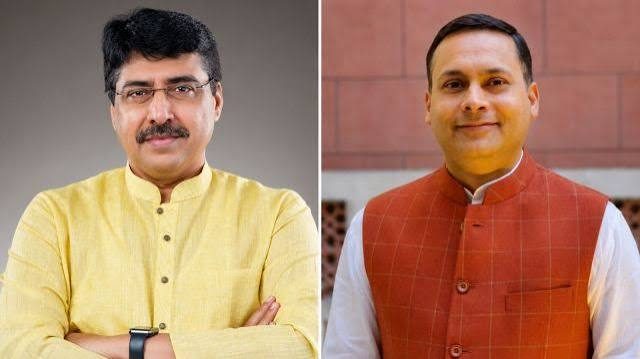
Quite rightly, of the three biggest takeaways, the first is Amit Malviya's eviction from a position he held for 11 years. His position -- Convenor IT Cell and Social Media -- was a position that the Modi regime inherited with the IT Cell being established during Rajnath Singh's tenure as party president in 2008.
It was raised with the impending 2009 Lok Sabha elections in mind.
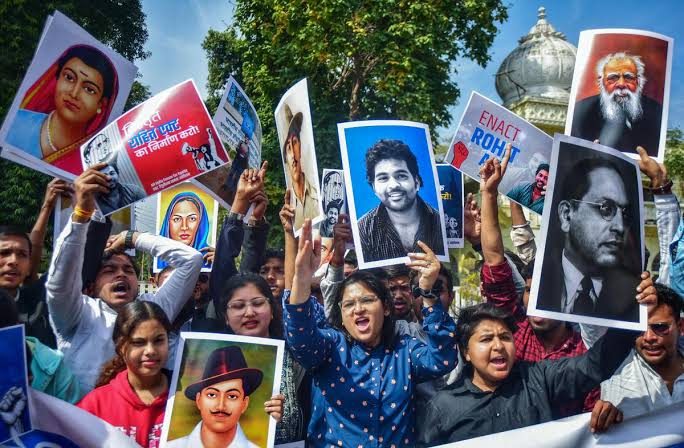
Till the students' and youth protest under the banner of Cockroach Janta Party and a few other students and youth outfits, no finger was ever pointed at Malviya.
But after his removal, suddenly everyone, with suggestions from the quarters that be, appear to be findings errors in the BJP's social media outreach.
Fact of the matter is, the entire party was flummoxed over the phenomenal rise of the Cockroach Janta Party within days of Chief Justice of India Surya Kant's uncalled for remark.
Even the government could secure little intelligence input about thousands of youngsters deciding to march into the citadel of the Indian capital on July 20, with intention of marching right up to Parliament.
Malviya paid the price because he committed the cardinal mistake of himself 'becoming' the BJP's IT Cell and its social media.
In the current BJP dispensation, the right to become bigger than the office one holds is vested only with one individual.
Malviya's removal contains a message to others -- never try to become bigger than the job that has been assigned.
The Return Of Smriti Irani : The second major takeaway is the return of Smriti Irani to the party secretariat.
Out of favour after her trailblazing start in 2014 when she was appointed Union human resource development minister, despite the controversy surrounding her educational degrees, she was soon cut down to size in ministries of lesser importance.
Her error was the same as Malviya's and eventually after the defeat from Amethi in 2024, at the hands of a loyalist from the Gandhi family she was really out in the cold.
Real humiliation was however, reserved for her in public -- that too after the BJP's questionable victory in West Bengal when Prime Minister Narendra Modi walked past her and greeted Mithun Chakraborty, the actor.
Irani has a role to play, at least in mounting spirited electoral campaigns, as evident in 2019 in Amethi and recently in West Bengal.
She has been appointed one of the eight general secretaries, but has not been given the organisational leadership for the assembly elections in Uttar Pradesh.
This task has been handed to a fellow general secretary, thereby underlining that she remains on watch.
Piyush Goyal's re-appointment as party treasurer is intriguing and there are no answers as yet.
Son of Ved Prakash Goyal, the party treasury chief for close to two decades starting from the time the party was established in 1980s, he too served in this capacity, before being inducted into the Union council of ministers.
Does his induction suggest that there is a likely cabinet reshuffle-expansion in the offing and using the one-person-one-post principle, Goyal would be moved from the government? However, principles in the BJP depend of the whim of the leadership.
Nadda remained the party president while being in the Union Cabinet from June 2024 to January 2026, and despite the publicised, retirement-at-75 to ease party veterans out of the ministerial equation, B S Yediyurappa was permitted to be Karnataka chief minister even though he was way past the age limit.
Like Irani, the other leader who has been politically rehabilitated is Ram Madhav. He too paid a price for personal reasons almost a decade ago but was in recent years, successful in building bridges with the Rashtriya Swayamsevak Sangh leadership.
However, his return is as one of the 13 vice presidents. The post, however, is chiefly of ornamental value but it will be important to keep track of special tasks he is assigned here onwards.
The position itself is too insignificant to bring in the BJP-RSS equation and theorise.
At the end of the exercise, this was a task that had to be completed as the leadership had no further excuse left to delay the appointments any further.
But beyond the enthusiasm for the headlines, the real work will continue to be done, as before and, right at the top.