
Ahmedabad: The Hingorani family's decision to part with the Gandhi archive after generations was guided by a desire to make it accessible to a wider audience and to fund initiatives that would extend its legacy.
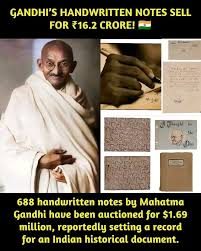
Mahatma Gandhi's 'A Thought for the Day' archive, comprising 688 daily reflections, sold for a record ₹16.20 crore ($1.70 million) at Saffronart's online auction.
The collection, preserved by the Hingorani family for over 80 years, offers an intimate look into Gandhi's life as a leader, mentor, and moral thinker.
Gandhi wrote these reflections daily from 1944 to 1946 for Anand T Hingorani, initially on embossed cards and later in a notebook.
Gandhi imposed a condition that these reflections remain unpublished until he had truly lived up to the ideals expressed, highlighting his commitment to ethical consistency.
The year was 1930. A young man from Sindh, all of 24 and deeply influenced by Mahatma Gandhi, joined the Dandi March held in defiance of the British salt tax.
His name was Anand T Hingorani. What began as political participation soon evolved into something far deeper and long-lasting.
Hingorani went on to join Gandhi at the Sabarmati Ashram in Ahmedabad, briefly edited the weekly Harijan, and took upon himself the task of collecting and cataloguing Gandhi's writings, including the vast correspondence addressed to him.
This instinct to preserve would shape one of the most important private Gandhi archives.
The Genesis of 'A Thought for the Day' : Among Hingorani's many initiatives was a simple yet profound request: He urged Gandhi to write a daily 'thought'. Gandhi agreed.
What followed was an extraordinary intellectual and moral exercise carried out over nearly two years.
From 1944 to 1946, Gandhi wrote 688 reflections, each dated, each intended as personal guidance, and each rooted in lived philosophy.
This very archive took centre stage at Saffronart's online auction, Gandhi: From the Collection of Anand T Hingorani, on August 18 and 19.
The sale, comprising 86 lots, achieved strong results, but it was A Thought For The Day that made history, selling for ₹16.20 crore ($1.70 million), setting a world record for an Indian historical document at auction.
Preserved by the Hingorani family for over 80 years, the collection offers an intimate window into Gandhi as a political leader, mentor, and moral thinker.
The archive itself is expansive, comprising letters, signed books, photographs, and personal objects. At its core rests the A Thought For tThe Day series.
Mahatma Gandhi's peti charkha and Two Letters on the Spiritual Discipline of Spinning, sold for ₹1.02 crore. Photograph: Kind courtesy Saffronart
Gandhi's Condition and Ethical Consistency : Hingorani, who owned a printing press, provided Gandhi with embossed cards on which these reflections were initially written.
"It's incredible that for almost two years -- 23 months to be precise -- every day, he wrote down a thought... and gave those to Anand Hingorani," says Saffronart Co-founder Minal Vazirani.
When the cards ran out, Gandhi continued writing in a notebook, which was also included in the sale.
However, Gandhi being Gandhi, he imposed a condition: These reflections would not be immediately disseminated.
Instead, he insisted that they remain unpublished unless he had truly lived up to the ideals they expressed. He did not wish "to preach... without living it," Vazirani explains.
Only after this period of self-examination did he permit Hingorani to compile them into a book. "So, you know, it was a trial for himself," she says.
This insistence on ethical consistency makes the archive more than historical documentation. It also turns it into a record of self-discipline and accountability.
'People are writing to me. I am writing to them' : Written primarily in Hindi (Devnagari script), the reflections touch on spirituality, humility, equality, and the conduct of everyday life, drawing from texts such as the Bhagavad Gita, the Ishwar Upanishad, and other devotional traditions.
They are, as Vazirani describes, "moments of philosophy... really talking about the conduct of everyday life".
Beyond the manuscripts, the auction included objects that embodied Gandhi's philosophy in practice, such as his peti charkha (portable spinning wheel), which was not just a symbol of economic self-reliance but also of spiritual discipline; "of doing a repetitive motion, just like, say, the act of repeating shlokas," says Vazirani.
The collection also speaks of Gandhi's global engagement.
Letters from around the world, preserved and passed on to Hingorani, document a dialogue between colonial India, which was largely isolated from the world, and an international community keenly observing how this non-violent struggle for independence would play out.
"'People are writing to me. I am writing to them'," Vazirani says, describing how Gandhi sought to bridge that divide.
Legacy and Cultural Shift : The Hingorani family's decision to part with the archive after generations was guided by a desire to make it accessible to a wider audience and to fund initiatives that would extend its legacy, such as documentary projects and educational resources, she adds.
Among other things, the record-breaking sale signals a resounding recognition of the relevance of Gandhi in the India of today.
It also, as Vazirani observes, points to a broader cultural shift: That today's Indian collectors are increasingly confident in "preserving our heritage... and being the arbiters of our own history".
That the archive remains within India only reinforces its symbolic importance.