
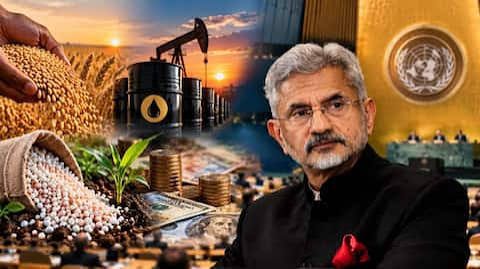
New Delhi : External Affairs Minister S Jaishankar has warned of a possible "4F" global crisis during his visit to the United States. The term does not refer to a new war or diplomatic group. Instead, Jaishankar was talking about a chain of problems that can spread from conflicts to food, fuel and family budgets, with developing countries likely to feel the impact first.
The answer is food, fuel, fertiliser and finance. Jaishankar described the situation at the UN General Assembly as a "4F crisis" that is hitting the Global South particularly hard.
At first, these may seem like four separate problems. But they are closely linked. Take fertiliser, for example. Producing it requires energy, while transporting it across countries depends on fuel, shipping routes and functioning supply chains. Farmers need affordable fertiliser to grow crops, while governments and businesses need access to finance to pay for imports and manage rising costs.
This means that a problem in one area can quickly affect the others, eventually reaching farmers, businesses and ordinary households.
How can a war far away affect your food bill?
This is where the 4F crisis becomes a problem beyond diplomacy. A conflict in one part of the world can disrupt energy supplies or force ships to take longer routes. That can push up fuel and transport costs, making fertiliser and other farm inputs more expensive.
Farmers facing higher costs may then have to spend more to grow crops. At the same time, countries that depend on imported food can end up paying more for grain and other essentials. These higher costs can eventually reach consumers through higher food prices.
Jaishankar referred to factors such as a "super El Nino", fertiliser shortages and disruptions to grain supplies while explaining the pressure facing developing countries. He warned that these problems can also make it harder for countries to meet their development goals.
Why is finance the fourth F?
Finance may seem less connected to food and fuel, but it can determine how well a country deals with the other three problems.
Governments need money to import food and energy, support farmers and build infrastructure. But countries already struggling with high borrowing costs or debt have less money available when prices suddenly rise or supplies are disrupted.
This is why financial stability becomes important during a global crisis. If a country cannot afford to pay for essential imports, a disruption in food, fuel or fertiliser supplies can become much more serious.
Jaishankar linked this issue to a broader concern about economic dependence. He said that finance, market access, supply chains, technology, resources and connectivity can all be used as forms of leverage.
Why did Jaishankar raise the 4F crisis again?
The 4F warning was not limited to Jaishankar’s speech at the UN. He referred to it again while speaking at the Asia Society in New York, where he discussed conflicts, instability and growing pressure on global supply chains.
"And a large part of the world faces what I, in my address to the General Assembly, called the 4F crisis, which is food, or fuel, or fertilisers, or finance. On top of this, supply chain vulnerabilities are growing," he said.
His comments underline how closely connected these problems have become. A conflict can disrupt shipping or energy supplies, which can increase the cost of fertiliser and food. At the same time, countries facing financial pressure may find it harder to absorb those higher costs.
What does India want to change?
Against this backdrop, Jaishankar has called for countries to reduce excessive dependence on individual suppliers and build more diverse and reliable supply chains. The idea is that countries should have alternatives when one source of food, fuel, fertiliser or other essential goods is disrupted.
India has also pushed for reforms in global institutions, arguing that developing countries should have a greater say in decisions that affect the global economy.
The central idea behind the 4F crisis is that food, fuel, fertiliser and finance cannot be treated as completely separate issues. A disruption in one can quickly put pressure on the others.
A country may have enough food today, for example, but still face problems if it cannot afford fertiliser for the next farming season or if conflict blocks the energy and shipping routes needed to move essential supplies.
In other words, the "4F crisis" is about how a crisis in one part of the world can travel through global supply chains and eventually affect farmers, businesses and household budgets elsewhere.