

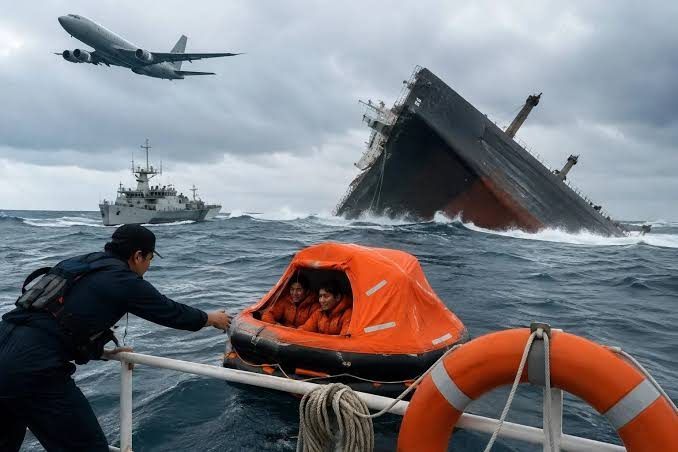
Kolkata : The MV Ocean Winner sank within about eight minutes with 24 crew aboard; experts say excess moisture in its iron ore fines cargo may have caused liquefaction.
A search operation by the Coast Guard and Indian Navy is underway for 22 seafarers missing after the MV Ocean Winner sank in the Bay of Bengal.
The 225-metre bulk carrier, carrying 72,200 tonnes of iron ore fines, reportedly tilted suddenly and sank within eight minutes.
Maritime experts suggest that cargo liquefaction, caused by excessive moisture in the iron ore fines, could be a reason for the rapid sinking.
Five days after the Panama-flagged MV Ocean Winner sank in the Bay of Bengal, the fate of 22 seafarers remains uncertain.
The 225-metre bulk carrier, carrying around 72,200 tonnes of iron ore fines loaded at Paradip Port, reportedly tilted suddenly before sinking within about eight minutes.
While only two of the 24 crew members aboard the vessel were rescued from life rafts on the day it sank in the deep sea, the remaining 22 seafarers were missing.
Three Coast Guard ships and the Indian Navy's surveillance aircraft P8I continued the search and rescue mission in coordination with the Maritime Rescue Coordination Centre (MRCC) at Sri Vijaya Puram (Port Blair).
"But there was no trace of the missing crew members," said a Coast Guard spokesperson.
Maritime experts said hopes are fading as the circumstances of the sinking have added another layer of uncertainty.
According to statements from the two rescued seafarers recorded by the Directorate of Maritime Administration, the vessel developed a list and sank within about eight minutes, forcing the crew to abandon the ship.
Though the search continues, the chances of finding survivors generally decline sharply after the first 12 hours.
The Indian Navy aircraft had spotted an oil slick and three liferafts around the vessel's last known position, although the ship itself has not been located.
"Such a rapid loss of stability would have left very little time for the crew to organise an orderly evacuation," said Captain Prashant Kumar Padhi, who worked for a Dubai-based company.
"Those present in the engine room might not have had sufficient time to abandon the ship. There is a chance they got trapped inside the ship," Captain Padhi added.
The unusually rapid listing and sinking have also put the condition of the iron ore cargo under scrutiny, with experts and officials suspecting cargo liquefaction caused by excess moisture as a possible reason behind the mishap.
Liquefaction occurs when certain fine-grained bulk cargoes containing excessive moisture lose their solid-like properties under the movement and vibration of a ship and behave more like a liquid.
The cargo can then flow towards one side as the vessel rolls, producing a sudden and potentially uncontrollable list.
Sources said the vessel had reportedly been waiting to load at Paradip since August 3, while the port area experienced heavy rainfall in the days preceding its loading.
If the iron ore fines had absorbed excessive moisture during prolonged exposure to rain, experts said the cargo's moisture content and transportable moisture limit would be crucial factors in determining whether liquefaction occurred after the ship sailed.
Authorities have not officially concluded that liquefaction caused the sinking.
"Wet iron ore fines can shift suddenly during vessel movement, producing a list and potentially triggering a rapid loss of stability," Captain Padhi said.
"There is a prescribed transportable moisture limit, and loading wet iron ore fines beyond that limit is not allowed. This must be properly investigated to see if all procedures and guidelines were followed," Captain Padhi added.
Meanwhile, the National Union of Seafarers of India (NUSI) has expressed deep concern over the incident, stressing that the safety of seafarers must never be compromised.
The union has called for all possible efforts to locate and rescue the missing crew, demanding proper safety standards and protection for seafarers working aboard international merchant vessels.
Chinese Ships Join Search Operation
Search and rescue operations for the 22 missing crew members were intensified as two Chinese vessels joined the mission on Tuesday.
Despite joint efforts by the Coast Guard, the navy and the Maritime Rescue Coordination Centre, no survivors have been found yet.
The search team, however, discovered an emergency beacon of the vessel and an empty lifeboat that were found floating, bringing the focus back on the circumstances that caused the vessel to tilt and sink within eight minutes.
The 225 metre vessel that sailed from Paradip port with over 72,000 tonnes of iron ore fines sank in the Bay of Bengal, nearly 230 nautical miles off the Odisha coast, on August 22.
Sources said additional Coast Guard assets and merchant vessels operating in the area have been deployed to expand the search grid.
ICGS Varad, in coordination with merchant vessels in the vicinity, is conducting an extensive search.
While the precise cause of the incident has not yet been established, the sudden sinking of the vessel has raised questions over whether all prescribed safeguards were followed before the iron ore fines, which were reportedly wet, were loaded at Paradip Port.
Officials suspected either cargo liquefaction or ageing condition of the vessel could be the reason behind the incident apart from the rough weather.
They said the investigation must not stop at determining whether the cargo was wet but should establish whether the entire chain of safeguards was properly followed.
"If liquefaction is established, it must be investigated whether the cargo was within its transportable moisture limit (TML) when it was loaded and whether the tests represented the actual cargo condition that went into the ship," said Captain Nakiran Velluswamy Mudaliar, senior vice-president of a shipping company.
Iron ore fines are specifically recognised under the International Maritime Solid Bulk Cargoes Code as a Group A cargo, meaning cargoes that may liquefy.
The International Maritime Organisation's schedule for iron ore fines says the cargo can liquefy if its moisture content exceeds the TML.
Experts said the probe would establish whether the required certificates were issued, independent surveys conducted, and there was any discrepancy between the documented condition of the cargo and its actual condition.
"There could be two reasons why the carrier capsized. First, it could have shifted due to liquefaction," said Captain Padhi. "Second, a structural failure, such as a crack, hull damage or even a structural break-up."