
DUBAI: The U.S. military announced Wednesday that it was conducting a 12th night of strikes against Iran as both sides increasingly targeted civilian infrastructure.
U.S. Central Command said the attacks were designed to "further degrade Iran's ability to threaten civilian mariners and commercial vessels transiting regional waters," as the Americans push to regain control over the Strait of Hormuz and restore the flow of international shipping.
President Donald Trump warned earlier Wednesday that the U.S. would destroy one bridge or power plant each time Iran shoots at a ship in the strait.
"From this point forward, any time the Islamic Republic of Iran shoots at a ship in the Strait of Hormuz, whether it be by Missile, Rocket, Drone, or any other device or weapon, the United States will bomb and destroy ONE BRIDGE OR POWER PLANT," Trump wrote on social media.
The continued American airstrikes are occurring even as diplomatic efforts show little public sign of progress and officials on both sides have dug in on the dispute over the crucial waterway for global energy that remains largely closed. The unpopular war threatens further worldwide economic disruption and is sending fuel prices up ahead of midterm U.S. elections this fall.
Seyed Abbas Araghchi, Iran's foreign minister, said his country would adopt an "eye for an eye" defense doctrine.
"Any aggression against Iran, including our infrastructure, will compel a powerful and decisive response," he posted Wednesday on X.
Iranian state media reported that U.S. missiles struck locations late Wednesday near the cities of Ahvaz, Ramshir and Andimeshk in western Iran. Two people were killed in a U.S. missile strike in the town of Shalamcheh on the Iraqi boarder, Iranian state media said early Thursday.
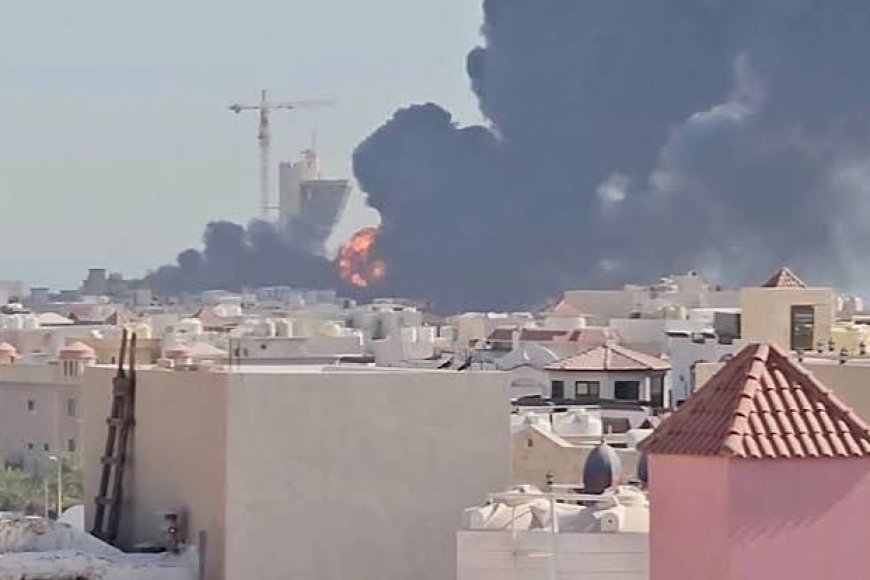
Meanwhile, military officials in Kuwait said on social media that their air defenses were "confronting attacks by hostile drones, following the sinful Iranian aggression."
Iran has responded to U.S. attacks by targeting energy infrastructure and desalination plants that provide drinking water in parched neighboring Gulf countries.
International law generally prohibits such attacks unless the infrastructure is being used for military purposes.
A billboard depicting U.S. President Donald Trump lying on what appears to be a coffin and bearing anti-Trump messages, including the phrase "We Kill Trump," is seen at Islamic Revolution Square in downtown Tehran, Iran, Wednesday, July 15, 2026.
The closure of the strait, through which a fifth of the world's traded oil and gas passed during peacetime, has jolted the world economy with effects far beyond the Middle East. A new threat by Iran-backed Houthi rebels in Yemen to target Saudi shipping in the Red Sea puts another trade chokepoint at risk.
Trump traveled to Dover Air Force Base on Wednesday for the arrival of the remains of four U.S. service members. A day earlier Defense Secretary Pete Hegseth estimated in a fiery Senate hearing that the U.S. had spent $37.5 billion on the war so far.
Benchmark Brent crude oil rose to more than $93 a barrel in trading. That's up from less than $72 early this month, which is roughly where it was before the war. Gasoline prices are also climbing.
Iran says it has the right to manage traffic and potentially charge fees in the strait, which was open to all and toll-free before the war. It has attacked ships using a route through the strait that is overseen by U.S. forces and intended to be outside Tehran's control.
Iran's parliament speaker, Mohammad Bagher Qalibaf, who has led negotiations with the U.S., appeared to brush off Trump's threats.
"We have repeatedly said that the situation of the strait will not return to prewar conditions," he wrote on social media.
A billboard depicting U.S. President Donald Trump lying on what appears to be a coffin and bearing anti-Trump messages, including the phrase "We Kill Trump," is seen at Islamic Revolution Square in downtown Tehran, Iran, Wednesday, July 15, 2026.
Diplomatic efforts show no signs of progress
Before the latest strikes, Iranian Interior Minister Eskandar Momeni visited Pakistan, a key mediator in the conflict, seeking to revive diplomacy. But it was unclear what new arrangement might be reached to end the war, which lately has become a battle for control over the Strait of Hormuz.
Iran's Interior Ministry spokesman Ali Zeinivand said "diplomacy isn't called off" and that messages were still being exchanged, without elaborating, according to IRNA.
An Arab diplomat said Gulf states are increasingly pessimistic about finding an off-ramp for escalating hostilities and are particularly concerned about the latest round of threats.
The diplomat said countries in the region, in addition to Pakistan and Turkey, are continuing to push for de-escalation. But, he said the chances for any improvement currently appear bleak. The diplomat spoke on condition of anonymity due to the sensitivity of the situation.
At a regional summit in the Philippines, U.S. Secretary of State Marco Rubio denounced Iran's actions in the strait.
"If we create a precedent in the Middle East where a nation state can decide that they are going to control an international waterway, charge a toll and if you don't pay them, blow up your ships, we have created a very dangerous precedent which will repeat itself in other parts of the world, including in this region," he said.
Rubio said the U.S. remains open to negotiations with Iran, "but right now they don't seem to be serious about that" so instead the focus is on protecting shipping.
In response to Iran's attacks, the U.S. re-imposed a blockade on Iranian ports.
Trump signals US may attack underground nuclear site
Speaking from the Oval Office on Tuesday, Trump gave a dim view on possible talks, saying the U.S. had "no interest in meeting."
He signaled that U.S. forces could soon target an under-construction Iranian nuclear site buried deep under a mountain.
The site, known as Pickaxe Mountain, lies on the south side of Iran's Natanz nuclear enrichment site, which was bombed by the U.S. during the 12-day war between Iran and Israel in 2025. But Pickaxe Mountain has remained untouched as Iran continues to dig at the site.
Iran has always insisted its nuclear program is peaceful, while resuming the enrichment of uranium to near weapons-grade levels since Trump scrapped a 2015 nuclear deal during his first term.
Trump threatens strikes on Iran bridges, power plants over Strait of Hormuz attacks
US President Donald Trump threatened Wednesday to knock out one Iranian bridge or power plant in return for each attack on shipping in the Strait of Hormuz, warning he was "not finished" with a war that has already cost Washington $37.5 billion.
Fighting over the strait led to the collapse of a preliminary deal between the United States and Iran, and Tehran has reimposed its blockade on the strategic conduit for oil and gas shipments, firing on vessels that seek to transit.
The blockade has rattled markets and sent oil prices climbing, adding to the pressure on Trump to find an off-ramp to a conflict that has hit Americans' pocketbooks heading into closely-fought midterm elections.
"Any time the Islamic Republic of Iran shoots at a ship in the Strait of Hormuz, whether it be by Missile, Rocket, Drone, or any other device or weapon, the United States will bomb and destroy ONE BRIDGE OR POWER PLANT," Trump wrote on social media, reiterating his longstanding threat to go after Iranian infrastructure.
But top US diplomat Marco Rubio maintained Washington is still willing to find a negotiated agreement with Tehran.
"We remain open to working it out in a negotiated way. But right now, they don't seem to be serious about that," Rubio said at a Southeast Asia ministers' meeting in Manila.
Iranian foreign ministry spokesman Esmaeil Baqaei had previously said that diplomatic exchanges with Washington through mediators were continuing.
On Wednesday afternoon, a US missile hit Larak island in the strait, Iran's Tasnim news agency reported, saying the extent of the damage was being investigated.
Trump has faced intense political pressure to end the conflict, which is unpopular even with segments of his political base as it nears its five-month mark.
Critics have pointed to the cost, which Pentagon chief Pete Hegseth said on Tuesday had soared to $37.5 billion, defending a request for tens of billions in additional funding for the military.
But Trump himself has so far bucked the pressure, saying on Tuesday: "We're not finished at all... we're not leaving right now."
The US military said it had launched an eleventh consecutive night of strikes against Iran, saying it targeted military sites to "further degrade Iran's ability to threaten commercial shipping in the Strait of Hormuz".
Trump had said earlier that the next US target could be an underground complex known as Pickaxe Mountain, or Kolang in Persian, a site near Natanz where Western intelligence agencies suspect Iran is building an undeclared nuclear enrichment facility.
Iran threatened reprisals, with the Khatam Al-Anbiya military command saying it would "consider it as an expansion of war" if such an attack were carried out, threatening strikes on "all the interests of America, the allies and supporters", the state broadcaster reported.
Foreign ministry spokesman Baqaei, meanwhile, insisted that "Washington's obsessive focus on Kolang Kouh where no nuclear activity is taking place is nothing more than a fabricated pretext for aggression, destruction, and sabotage".
The head of the UN nuclear watchdog, Rafael Grossi, told the BBC that inspectors "should be there already" in reference to Iran, saying it was important that the IAEA check on Iran's stockpile of highly enriched uranium.
The threats came as Tehran pressed its assault on targets in US-allied Gulf states.
Kuwait's army said its air defences were engaging drones from Iran, while Jordan said it had shot down four Iranian missiles and four drones.
Air alert sirens also sounded in Bahrain, with an AFP correspondent in Manama hearing an explosion.
The Iranian military said it targeted US assets in Kuwait and Bahrain, including air defence systems, radar installations and administrative buildings.
Iran's Revolutionary Guards also said they had targeted US bases in Jordan.
After Tehran's Houthi allies in Yemen threatened to blockade Saudi ports, Trump said he would "take care of" the rebels if they followed through.
It remains unclear how the Houthis would enforce such a blockade, but it would only compound the effects of the Hormuz closure.
Brent Crude, the global benchmark, briefly topped $95 a barrel for the first time in six weeks on Wednesday, but shed some of the gains.
The Houthis are yet to resume their attacks on shipping, but maritime intelligence provider Vanguard Tech said a Singapore-flagged tanker and a Liberia-flagged tanker both "reversed course" in the Red Sea after loading crude at the Saudi port of Yanbu.
If the Houthis make good on the threat, they could endanger Riyadh's ability to bypass the Strait of Hormuz for some oil exports, with major repercussions for the global economy.
During the Gaza war that began in October 2023, the Yemeni rebels attacked shipping in the Red Sea and Gulf of Aden, forcing vessels to make a long detour around Africa and prompting a US bombing campaign.