
Ladakh : The Indian Army captured Thang in Ladakh in the 1971 War. Ghulam Hussain who had left home in PoK for a routine errand found himself on the other side of an altered border. He never returned and found a country, a new home.
Indian Army captured four villages from Pakistan in the 1971 War. Thang, one of the four, is India's northern-most village. Many families were split across the border.
The message that we are very close to India's northern-most village is painted on a cute blue bridge built by the Border Roads Organisation.
The BRO is a constant companion in Ladakh. These roads take you almost everywhere you go and leave you amazed at the brilliance of the engineers and labourers who have constructed them at one of the world's most unforgiving terrains in oxygen-deficient altitudes ranging from 10,000 to over 19,000 feet.
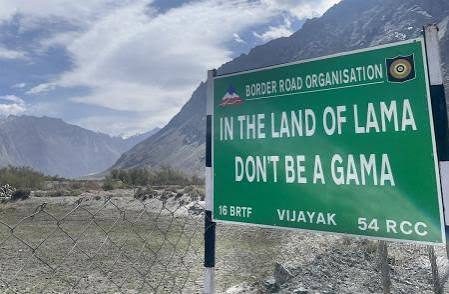
And if that was not enough, they have the most hilariously witty driving advisories along the way that would put the best of copywriters to shame.
Don't be a Gama in the land of Lama... and many, many more that leave you smiling throughout the beautiful drives of Ladakh - and linger on long after your return.
The BRO constructs and maintains roads/bridges on some of the most strategic and sensitive border areas including the Siachen Glacier. Along the way, there are signages of Project Himank, the name given to this project which began in 1985.
BRO recently constructed the world's highest motorable road at Mig-La Pass at 19,400 feet in Eastern Ladakh a few months ago which is yet to open for tourists.
It also runs a restaurant called Cafe Himank at 13,800 feet, 30 odd kilometres before Pangong Lake, a popular pit stop.
When we hop off the car in Thang, the last village ahead of Turtuk in Ladakh, there is already a few bunches of tourists making their way to a one-storied terrace which gives a vantage point across the Line of Control.
Among the visitors is a group of Buddhist monks who graciously agree for a photograph with us.
But there is one man who impossible to miss. He sits in a chair at the landing of the steps with a board with his introduction and an interesting story for the ages.
His name is Ghulam Hussain. He lived in Pakistan occupied Kashmir for the first 18 years of his life. The village where he was born and raised as a Pakistani is just across the LoC, 2.2 kilometres away.
Two days before the 1971 War broke out, Ghulam Hussain left home to fetch urea for his fields. He was 18, married and living with his parents.
He could never return.The Indian Army captured four villages from Pakistan, including Thang, Turtuk, Tyakshi, and Chalunka.
Ghulam Hussain who had left home for a routine errand found himself on the other side of an altered border.
Twenty-three years after Independence, these villages once again became a part of India -- and so did Ghulam Hussain.
In Thang, families like Hussain's were split across the LoC. He remained in India while his family stayed in Pakistan.
He never returned to his village and rebuilt life again as an Indian citizen. He remarried, had children and grandchildren and made a better life here, he says.
Our guide, a sweet lady of Balti heritage, tells us that villagers of Thang can go and meet relatives on the other side after obtaining a Pakistani visa, but that is far from simple.
Even if they get the visa, it is not as if they can just walk the 2.2 kilometres that separates them from their kin. It entails travelling to the Wagah border in Punjab which is the designated land entry point for civilians.
Punjab is a long distance away and travel expensive. It is just not feasible. People have all settled down to their lives and have grown roots here, she says.
Standing there I thought how many villagers in those early years must have stood here looking out for their loved ones on the other side.
The decorated soldier who led the way
Colonel Chewang Rinchen, the Ladakhi Indian Army officer who was of Major rank during the 1971 War, led the offensive in the liberation of these four villages from Pakistan.
Belonging to this region of Ladakh, he received his second Mahavir Chakra, the second highest medal for gallantry in war for his courage and ingenuity in battle at sub-zero temperatures at such punishing heights.
Colonel Rinchen is only among six brave soldiers who have received the Mahavir Chakra twice, he played a significant role in winning the trust of the locals after the war.
It tells us that winning a war is as much about winning the hearts and minds of the people as attaining military objectives. History is shaped that way.
From the viewing point, the Shyok river meanderes from India into PoK. The guide gives you binoculars (for Rs 50 extra) with instructions to look out for the no man's land, LoC, the agricultural land and village of Franu in the Gilgit-Baltistan region of PoK.
Then she points to the mountains indicating the Indian Army bunkers and the Pakistani posts on the other side. It is difficult to spot them in the overpowering mountain tops.
An Indian flag flies high from the view point at Thang marking the northern-most edge of our vast country.
The mountains and ridges are timeless, unmoved by the borders and the reality of a conflict that makes the LoC the most heavily guarded frontier in the world.
But that day, I left with thoughts about Ghulam Hussain, the man who left home to buy fertiliser and could never walk that 2.2 kms journey back. In the time that he was gone, the map had changed and given him a country which he now calls home.