

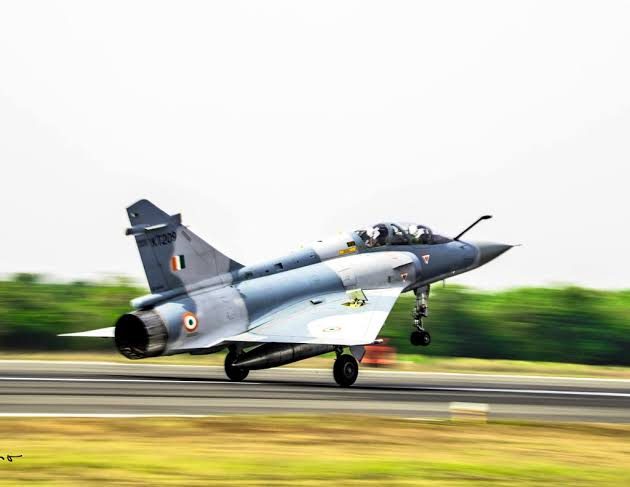
BENGALURU : It will give the IAF a dedicated communication system for secure and long-range contact between aircraft, bases and command centres.
With launch planned for 2027-28, the project advances India’s indigenous defence and space capabilities.
In a Bengaluru laboratory, engineers at the U R Rao Satellite Centre are building a machine that will one day orbit nearly 36,000 kilometres above the Indian Ocean.
It must keep Indian Air Force (IAF) pilots, bases and command centres in contact even when other communication systems fail. Its name is GSAT-7C.
On October 15, 2026, it moved from a long-held promise to a signed commitment, when the Ministry of Defence inked a contract worth Rs 2,563 crore (about US$270 million) with NewSpace India Limited, an ISRO's commercial arm, to build and launch it.
The signing took place in New Delhi along with a Rs 1,543 crore deal for Varunastra torpedoes for the Navy, taking the day's total to roughly Rs 4,106 crore.
To understand its importance, imagine a fighter pilot streaking over the Arabian Sea or a transport crew threading a Himalayan valley. Ordinary radios work much like shouting across a field. Once the signal slips beyond the horizon or behind a mountain, the voice simply cuts out.
The GSAT-7C exists to solve that ancient problem. It will be parked in geostationary orbit, a special height where a satellite circles the earth at exactly the planet's own rotation speed and so appears to hang motionless over one spot.
There it becomes a fixed relay in the sky. A message sent upward from one corner of the country bounces back down to another, no matter how far apart the two ends are. Engineers call this "beyond the line of sight" communication.