
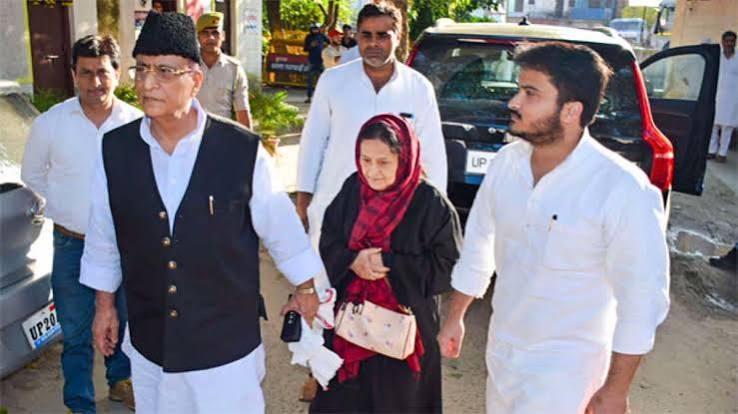
New Delhi : The proceedings arose from three separate petitions filed before the Supreme Court, including one by the Uttar Pradesh government challenging the relief granted to Azam Khan and two others filed by Abdullah Azam Khan and Tazeen Fatima against the Allahabad High Court's refusal to stay their convictions.
SC upholds Azam Khan’s relief in fake birth certificate case, extends it to wife and son.
The Supreme Court on Tuesday rejected the Uttar Pradesh government’s appeal against the Allahabad High Court order that suspended the conviction and seven-year jail term of Samajwadi Party leader Mohammad Azam Khan in the fake birth certificate case.
A Bench of Justices Dipankar Datta and Sheel Nagu went further and stayed the convictions of Khan’s wife, Tazeen Fatima, and son, Abdullah Azam Khan, giving them the same relief.
Three petitions were before the top court. The state government challenged the relief given to Azam Khan, while Abdullah Azam Khan and Tazeen Fatima separately contested the High Court’s refusal to put their convictions on hold.
The High Court had stayed Azam Khan’s conviction and sentence in May 2024 but turned down the same request from his wife and son.
All three were already out on bail. Aggrieved by the High Court's decision, the Uttar Pradesh government approached the Supreme Court, seeking to set aside the relief granted to the senior Samajwadi Party leader.
Meanwhile, Abdullah Azam Khan and Tazeen Fatima challenged the High Court's refusal to stay their convictions, stating that they too had been sentenced to seven years' imprisonment by the trial court in the same case.
The case dates back to January 3, 2019, when Akash Saxena, now a BJP MLA from Rampur, lodged a complaint alleging that Azam Khan and his wife had procured two birth certificates for their son.
According to the prosecution, one birth certificate issued by the Rampur Municipality mentioned Abdullah Azam's date of birth as January 1, 1993, while another certificate showed his date of birth as September 30, 1990, in Lucknow.
On October 18, 2023, a sessions court convicted all three and sentenced them to seven years' imprisonment in the alleged forgery case.
The trio was convicted under various provisions of the Indian Penal Code (IPC), including Sections 420 (cheating), 467 (forgery of valuable security), 468 (forgery for the purpose of cheating), 471 (using a forged document as genuine) and 120-B (criminal conspiracy).