
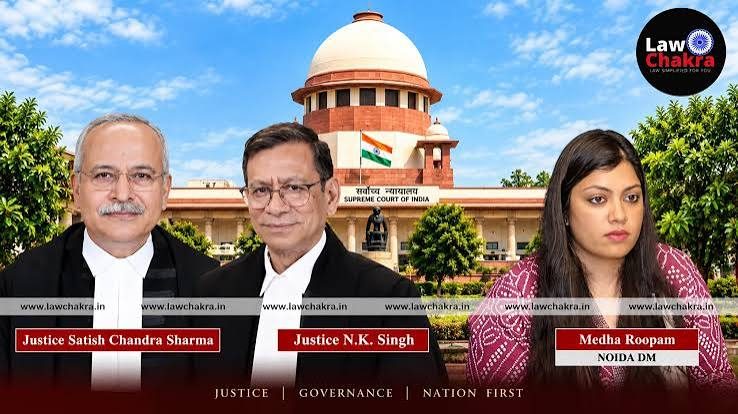
Gautam Buddh Nagar District : The Supreme Court has intervened, staying a significant Allahabad High Court order that mandated Gautam Buddh Nagar District Magistrate Medha Roopam to pay Rs 5 lakh compensation from her salary for the controversial detention of student Akriti Chaudhary under the National Security Act.
SC stays Allahabad HC order against Noida DM reprimanding her for student's detention under NSA
The Supreme Court has stayed the Allahabad high court's order regarding compensation from DM Medha Roopam's salary.
The high court had directed DM Roopam to pay Rs 5 lakh for the 'concocted' detention of Akriti Chaudhary under the National Security Act (NSA).
The Supreme Court also stayed the high court's critical observations made against the district magistrate.
The case originated from Akriti Chaudhary's detention during the Noida workers' protest in April, where NSA was invoked.
The high court had previously emphasised that bureaucrats' loyalty must be to the Constitution, not the political executive.
The Supreme Court on Wednesday stayed the operation of the Allahabad high court order directing Gautam Buddh Nagar District Magistrate Medha Roopam to pay compensation of Rs 5 lakh from her salary for the detention of student Akriti Chaudhary under the National Security Act (NSA) in connection with the Noida workers' protest in April.
A bench of Justices Satish Chandra Sharma and N Kotishwar Singh issued notice on Roopam's plea and stayed high court's direction quashing Chaudhary's detention.
The top court passed the interim orders on two separate pleas filed by Roopam and the Uttar Pradesh government.
Supreme Court's Interim Order
During the brief hearing, the bench heard Solicitor General Tushar Mehta, appearing for the district magistrate (DM), and senior advocate Mukul Rohatgi for the state of UP, before it muted the audio of the video conference proceedings.
The bench also stayed the observations made in the high court order against the DM.
'After hearing senior counsels for the parties, this court is of the opinion that till the matter is heard on merits, the operation of the impugned judgment, particularly, para Nos. 27 to 33 shall remain stayed,' it ordered and posted the matter for further hearing on October 7.
Senior advocate Collin Gonsalves appeared for Chaudhary on caveat.
Allahabad High Court's Original Ruling
On September 2, the high court quashed the detention of Akriti Chaudhary, a 25-year-old Delhi University history graduate, who was taken into custody under the NSA in connection with the Noida workers' protest in April.
Allowing Chaudhary's habeas corpus petition challenging her arrest, the high court found that the detention was based on a story 'concocted' by the state and directed her immediate release if her arrest was not warranted in any other case.
Criticism Of Bureaucracy And Compensation
It strongly criticised the manner in which the detention order was passed by Roopam and warned that continued 'despotic' conduct by 'errant' bureaucracy could reduce Uttar Pradesh to an 'Orwellian dystopia'.
It also awarded Rs 5 lakh compensation to Chaudhary and directed that the amount be recovered from the salary of Roopam, who passed the detention order, as well as other officers responsible right down to the SHO.
Broader Implications For Governance
On September 9, Solicitor General Mehta told the Supreme Court that an appeal would be filed against the high court decision quashing the detention order.
Chaudhary was arrested in connection with cases arising from the Noida workers' protest and the Uttar Pradesh Police subsequently invoked NSA against her and activist-journalist Satya Verma on May 13.
They were among several activists arrested in cases relating to the protest seeking higher wages.
In the order, the high court also made several significant observations on the roles of the bureaucracy and the police.
It said officers are entrusted with immense powers because they bear responsibility for upholding the constitutional and legal rights, dignity, honour and welfare of citizens.
However, the court stressed that bureaucrats must remember that their 'loyalty is towards the Constitution and not the political executive'.
It further said that officers are servants who serve the people, who are 'the masters in a democracy'.
It directed that the high court's displeasure against the DM and police officers involved in preparing the dossier be recorded in their service records.