
New Delhi : The petitions sought Kumar's suspension and the quashing of decisions he allegedly took alone. They also asked for an investigation by a special investigation team (SIT), headed by a retired Supreme Court judge, into the deletion of voters' names during the SIR.
SC issues notice to Election Commission, refuses to suspend Chief Election Commissioner
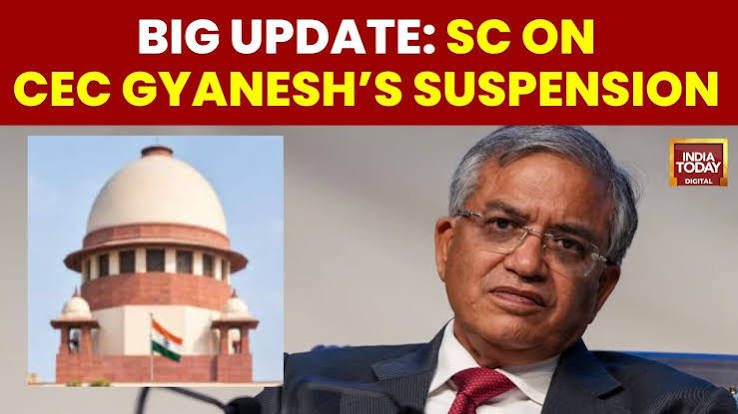
The Supreme Court on Monday issued notice to the Election Commission, the Chief Election Commissioner and the Centre, seeking their responses to petitions that demand the suspension of Chief Election Commissioner Gyanesh Kumar.
The court declined to pass any interim order, while making clear that it can reverse commission decisions that were not taken unanimously or by majority.
In today's episode of DNA, Rahul Sinha, a section of media's managing editor, conducted a detailed analysis of the hearing, which concerned two petitions linked to the dispute over the Chief Election Commissioner and the Special Intensive Revision (SIR) of electoral rolls.
The petitions sought Kumar's suspension and the quashing of decisions he allegedly took alone. They also asked for an investigation by a special investigation team (SIT), headed by a retired Supreme Court judge, into the deletion of voters' names during the SIR.
Arguing for the petitioner, counsel said the country was facing a grave situation that was undermining the foundations of democracy, and asked for an interim order suspending the Chief Election Commissioner.
It was claimed that, without such an order, the whole country could burn. The court replied that a suspension could bring the commission's work to a halt, and asked who would then conduct elections.
The petitioner then proposed that the court direct the commission to take decisions only unanimously or by majority. Chief Justice Surya Kant said the law already provides for this and that the court expected the commission to follow it. "If there has been any violation, we can reverse that decision as well," he said.
The petitioner added that the Chief Election Commissioner's unilateral decisions had affected the electoral roll itself.
The court said it could not pass a one-sided order without hearing the parties concerned. If the record showed that a decision had not been taken unanimously or by majority, it could stay that decision.
The court also expressed hope that the Chief Election Commissioner and the commission would respond clearly and transparently.
The Chief Justice also remarked on Form-6, the form used to register as a new voter, saying the Supreme Court had not approved any change to it. The matter has been in the news since an English-language newspaper reported that the new Form-6 was introduced by overriding the views of two Election Commissioners.
The Election Commission has said that no change was made to Form-6. It says a declaration was attached as an additional document, and that the decision was taken unanimously. In a press release on 26 September, it added that the declaration had the Supreme Court's approval.
Rahul Gandhi, Leader of the Opposition in the Lok Sabha, alleged that the Chief Election Commissioner had altered Form-6 illegally.
The commission posted a fact-check calling his claim misleading. It said it had unanimously issued the order for the SIR in Bihar on 24 June 2025, and that the Supreme Court upheld that order in its judgment of 27 May 2026. The Congress has stood by its allegations.
The key points from the hearing are as follows. The court did not approve any change to Form-6. It refused to suspend the Chief Election Commissioner because doing so could affect the commission's functioning.
It will, however, examine whether he took unilateral decisions by setting aside the views of the other commissioners, and such decisions may be quashed if necessary. It also said that orders cannot be passed solely on the basis of media reports, and that the parties must be heard.
The next hearing will follow the filing of responses. The Bharatiya Janata Party described the hearing as part of the judicial process.
The Constitution gives the Supreme Court no power to suspend a Chief Election Commissioner. Only Parliament can remove him, through impeachment, in the same manner as a Supreme Court judge. The court can, however, examine the commission's decisions and stay or quash any found to be contrary to law.
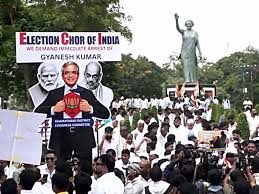
The hearing came as the opposition INDIA bloc protests across the country against Mr Kumar. Its MPs will march to the Election Commission tomorrow, gathering at Parliament's Makar Dwar at 10.30am, with the march starting at 11am.
The Congress has also announced the next phases of its campaign. The second phase will run from 10 to 20 October, with bike rallies, padayatras and cycle rallies at block level. The third will run from 25 October to 25 November. On 26 November, Constitution Day, six major yatras will set out from different parts of the country.
The party appears to be turning the protest into a mass movement. Separately, the Cockroach Janta Party has announced an agitation at Jantar Mantar in Delhi on 10 October, meaning the Congress and the CJP will pursue the issue on separate fronts.