
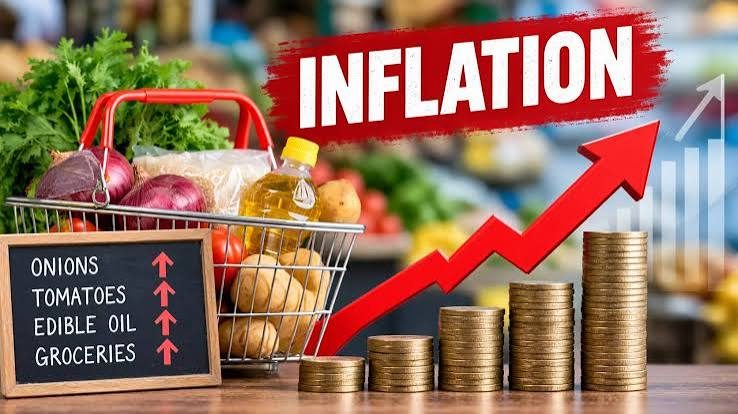
Mumbai : India's retail inflation climbed to 5.54 per cent in September, primarily driven by a sharp increase in onion and other food prices, pushing it just within the Reserve Bank of India's tolerance range and prompting concerns about future price stability.
India's retail inflation, measured by the Consumer Price Index (CPI), rose to 5.54 per cent in September, up from 4.83 per cent in August.
Food inflation significantly increased to 7.74 per cent in September, with onion prices soaring by 108.09 per cent.
The Reserve Bank of India recently hiked its repo rate by 25 basis points to 5.50 per cent and raised its inflation forecast for the current fiscal year to 5.2 per cent.
Economists anticipate food inflation to remain firm due to weak rainfall and broadening price pressures beyond food, including elevated crude oil prices.
The government mandates the RBI to maintain inflation at 4 per cent, with a 2 per cent margin on either side.
Retail inflation rose sharply to 5.54 per cent in September on the back of high onion and other food prices, remaining just within the RBI's tolerance band, government data released on Monday showed.
The consumer price index (CPI) based headline inflation was 4.83 per cent in August.
Food inflation rose to 7.74 per cent in September from 5.97 per cent the previous month, according to the National Statistics Office (NSO).
Key Inflation Drivers
The top five items with high inflation were onion (108.09 per cent), silver jewellery (87.8 per cent), ginger (62.85 per cent), garlic (54.62 per cent) and lemon (36.41 per cent).
On the other hand, inflation in potatoes, tomatoes, motor cars and jeeps, lady's fingers, and coconuts remained negative.
CPI rates for rural and urban areas are 6.08 per cent and 4.88 per cent, respectively, while the All India Consumer Price Index (CPI) with base year 2024 for September is 5.54 per cent.
September inflation numbers are the highest since the new series, with base year 2024, took effect in January.
RBI's Stance and Forecast
Last week, the Reserve Bank of India (RBI) raised its benchmark repo rate by 25 basis points to 5.50 per cent, its first hike in nearly four years, while signalling that rate cuts are off the table in the near term and that further hikes could follow amid rising inflation, a weak rupee and high crude oil prices.
It also marginally raised the forecast for retail inflation for the current fiscal year to 5.2 per cent from its earlier estimate of 5 per cent, saying price pressures are increasingly becoming visible across a range of commodities.
CPI inflation for 2026-27 is projected at 5.2 per cent, with Q2 at 4.9 per cent, Q3 at 6.0 per cent, and Q4 at 5.7 per cent.
The government has mandated the central bank to keep inflation at 4 per cent, with a margin of 2 per cent on either side.
Regional Impact and Expert Commentary
The top five states with high inflation were Tamil Nadu, Odisha, Madhya Pradesh, Telangana and Andhra Pradesh, NSO data showed.
The lowest inflation was in Mizoram.
Commenting on the data, Dipti Deshpande, Senior Director and Principal Economist at CRISIL, said food inflation is likely to remain firm in the coming months as weak rainfall weighs on agricultural output.
She further said that price pressures are broadening outside food as well.
"Brent crude prices are expected to average $88-93 per barrel in fiscal 2027, 25-32 per cent higher on-year, keeping retail fuel prices elevated.
"At the same time, robust demand conditions are giving producers greater latitude to pass higher energy, transport and other input costs on to consumers, adding to underlying inflationary pressures," Deshpande said.
Devendra Pant, Chief Economist, India Ratings and Research said food inflation recorded a 21-month high growth of 7.74 per cent yoy (August 2026: 5.97 per cent; July 2026: 5.52 per cent).
Mass-consumption items like ginger, garlic, and lemon recorded high double-digit growth, while onion recorded triple-digit growth.
Rise in food inflation was due to a combination of seasonal increase in food inflation, adverse base effect (food inflation in September 2025 was (-)2.33 per cent) and El Nino," Pant said.
Madhavi Arora, Chief Economist, Emkay Global Financial Services expects 3QFY27 inflation to average close to 6.1 per cent, implying the real policy rate would stay negative even with higher rates.
"We reckon that beyond oil-related input costs, adverse weather is adding to food-price pressures, with El Nino potentially persisting into 2027.
"Cyclical production swings and greater crop diversion to biofuels add further supply-side risks," Arora said.
NSO collects real time price data from selected 1,407 urban markets (including online markets) and 1,465 villages covering all States/UTs on a weekly roster. During September 2026, the response rate was 100% in both rural and urban markets, NSO said.