
New Delhi : The question, therefore, is not whether a police officer can have faith. They can. Nor is it about taking away anyone’s right to practise or express their religion.
Mustakim Khan, Anuj Chaudhary, Bushra Bano and K Shilpavalli are all Indian police officers serving in different states, but that’s where the similarity ends: while Chaudhary and Shilpavalli can take part in Hindu religious processions while on duty, Khan and Bano cannot openly participate in festivities connected with their faith and are ‘punished’.
Their cases raise questions over how religious expression and participation are treated differently within the police force.
Several videos of Hyderabad Police officers on bandobast duty—both men and women—dancing exuberantly with devotees to religious tunes during the Khairatabad Bada Ganesh immersion have surfaced on social media platforms.
One such video shows Additional Commissioner of Police (ACP) Sanjay Kumar being lifted by his colleagues as he happily danced during the procession. Madhapur Deputy Commissioner of Police (DCP) and IPS officer K Shilpavalli was also seen cheering her officers, seeking blessings from Ganesha.
The videos are well received. And there is nothing wrong with praising one’s faith.
But one cannot help but notice the stark contradiction or biased treatment a Hindu officer receives when compared to his/her Muslim colleague in the same situation.
Take the case of Bihar Police Sub-Inspector Mustakim Khan. His sword-wielding video during the Muharram procession in Muzaffarpur while on duty came under scrutiny, resulting in a show-cause notice. He was sent to the police lines as a punitive transfer.
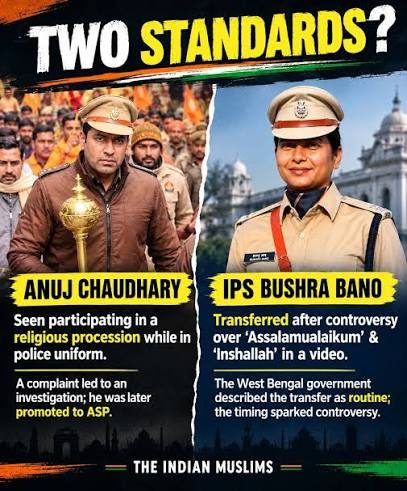
Last year, Additional Superintendent of Police Anuj Chaudhary, then a Circle Inspector in Uttar Pradesh’s Sambhal district, participated in a Hindu religious procession, wielding a mace during a Gada Yatra procession.
Chaudhary and Mustakim Khan’s actions were similar. Both were on duty, but only one faced departmental action.
The Indian Police Service (IPS) officers are facing alleged religious discrimination. West Bengal IPS officer Bushra Bano was the Additional Superintendent of Police in Kharagpur.
West Bengal IPS officer Bushra Bano was transferred after she posted a video, sharing her civil service journey. She greeted with “Assalamualaikum,” “Inshallah” and signed off with “Jazakallah.”
What followed was a complaint by the Hindutva organisation, Hindu Legal Fund, to the Bengal Home Secretary, alleging that Bano did not say Vande Mataram or Jai Hind, and that it is an insult to the uniform.
Bushra Bano’s video largely focused on her journey from an assistant professor in Saudi Arabia to one of India’s most prestigious government posts. But the Suvendu Adhikari-led government did not see that. They saw only three words: Assalamualaikum, Inshallah, and Jazakallah.
She was immediately transferred as Deputy Commandant of the State Armed Police (SAP) 4th Battalion, again considered a punishment transfer.
But what about the time when CV Anand performed a pooja in his office when he took over as Telangana Director General of Police (DGP)?
Trinamool Congress (TMC) senior leader and Lok Sabha MP Mahua Moitra questioned IPS and IAS associations over their inability to address the alleged religious discrimination faced by senior Muslim officers in Bengal after the Bharatiya Janata Party (BJP) came to power.
She named instances during Union Home Minister Amit Shah’s tour to the state: Siliguri Police Commissioner Waquar Raza was barred from the welcome lineup. In another episode, Director General of the Special Task Force (STF) Jawed Shamim was allegedly not invited.
The question, therefore, is not whether a police officer can have faith. They can. Nor is it about taking away anyone’s right to practise or express their religion.
The real question is whether the same standards apply to every officer in uniform.
If participating in a religious procession or displaying religious expression while on duty is considered a breach of neutrality in one case, the same standard should apply regardless of whether the officer is Hindu, Muslim or belongs to any other faith.
The contrasting treatment of these cases raises an uncomfortable question: is religious neutrality being applied consistently within the police force, or does it depend on whose faith is being expressed?