
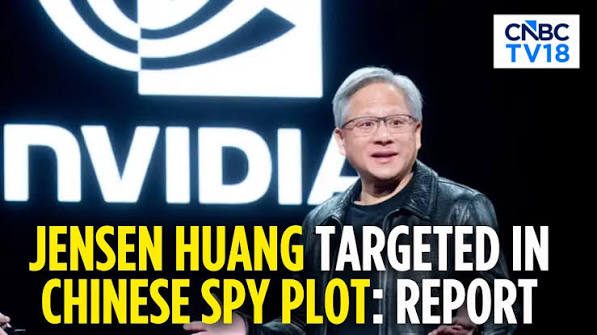
New York : Nvidia CEO Was China Spy Target, Says Report. He Says Ties Were 'Normal' Trump was briefed on the intelligence roughly a year ago but chose not to act.
Nvidia CEO Jensen Huang has said that the chipmaker's dealings with a company which is under investigation for spying on behalf of China were "normal and not unusual".
His comments came after The New York Times reported that Huang was the target of a Chinese spy plot which was coordinated by a businesswoman who built a close relationship with him and was passing advanced Nvidia AI Chips and intelligence to Beijing.
Alice Huang, a Chinese citizen, and top executive at Singapore-based data centre company Megaspeed was identified by US spy agencies as an intelligence asset for China.
The Times described her as a Chinese investor and businesswoman who rose to a top executive position at Megaspeed, a company the Commerce Department began investigating late in the Biden administration over concerns that it was helping China bypass US restrictions to acquire Nvidia AI chips.
Nvidia's relationship with Megaspeed's officials was proper, and the chipmaker has checked to ensure that Megaspeed didn't illegally send its artificial intelligence processors to China, Huang said in an interview on Thursday.
“We've studied all their deployments of our GPUs and counted every one,” he said. “And I think the US government also has as well.”
Huang also said that his interactions with her were typical of those with Chinese customers and executives. She's no longer with Megaspeed, he said.
“Our relationship, our interactions, have been related to Megaspeed, and it was all completely normal and not unusual,” Huang said.
He also said he hadn't been informed by the US government of its suspicions about Alice Huang, also known as Huang Le.
US President Donald Trump was briefed on the intelligence roughly a year ago but chose not to act. The report, citing officials, stated that Trump was hesitant to disrupt Nvidia's booming business which is keeping the US economy and stock market afloat and was worried about impeding trade relations with China.
Other alarming possibilities included the Nvidia chief's insights into Trump's thinking, owing to his close relationship with the Republican leader. After investigations were launched by US authorities, Huang reduced her role in Megaspeed's daily operations.
The report stated that some senior officials in the administration doubt that the Nvidia chief was unaware of Huang's intelligence-gathering role for China.
However, Nvidia's spokesperson John Rizzo said that "Jensen's interactions with Ms. Huang are not unusual or unexpected. Meetings with customers are part of a C.E.O.'s job; Jensen talks with thousands of customer executives every year."
He said that customers like Megaspeed "receive ordinary business information -- not sensitive Nvidia trade secrets -- and zero information relevant to national security."
Besides, the company Huang worked at, Megaspeed, had already been investigated by Nvidia after which they debunked claims that it was smuggling chips to China.
Nvidia stated that there is no evidence that its chips are being smuggled to China and that the government there has already blocked US AI chips from entering the country to protect its industry.
The Chinese Embassy in Washington rejected the espionage claims and said that the allegations were part of a broader, politically motivated campaign by the US to deploy "groundless smears and slanders" against China.
Despite US government export curbs initiated in 2022 to block advanced Nvidia semiconductors from entering China, some entities have illicitly smuggled the hardware across the Chinese border.
Concurrently, other enterprises have leveraged a legal avenue by establishing operations in Southeast Asia to acquire large volumes of chips, building data centers that rent computational capacity out to Chinese firms.
While some US policymakers viewed this infrastructure pipeline as a problematic regulatory loophole, leading the Biden administration to introduce restrictions, the Trump administration subsequently rolled back those measures.
The US government is currently deliberating whether to reinstate tighter controls on the practice, which directly impacts overseas data centre operators like Megaspeed that acquire these chips to service the Chinese market.
When the US conducted an electronic surveillance of Huang, they found that she was in contact with a US citizen.
US intelligence agencies generally need a court order to spy on American citizens, but an "unmasking" process can reveal a citizen's identity if a government agency shows a valid need to understand intercepted foreign communications, which in this case identified Nvidia Chief Jensen Huang to be her US contact.
Prior to 2025, the Nvidia CEO rarely visited Washington and kept his distance from politics.
However, when the Trump administration weighed a ban on shipping Nvidia semiconductors to China, the Nvidia chief and his wife attended a high-end donor dinner at Trump's Mar-a-Lago resort. There, he personally lobbied the president to permit tech firms to continue their commercial operations with Beijing.
Nvidia has donated at least $20 million to Trump's ballroom fund and pledged $500 billion toward US manufacturing. Even during Chinese President Xi Jinping's state dinner at the White House last month, Nvidia's CEO was seated at the head table.
Jensen Huang speaks alongside Trump about investing in America, at the White House
Jensen Huang speaks alongside Trump about investing in America, at the White House
Photo Credit: AFP
Last year, Trump permitted Nvidia to sell older-generation chips to China in exchange for a portion of the revenue. Looking to improve relations with China ahead of his summit with Xi, the president considered a request from the Nvidia CEO to export even more advanced technology.
Although this proposal upset some congressional Republicans and administration officials, Trump ultimately chose not to approve the more powerful sales.