
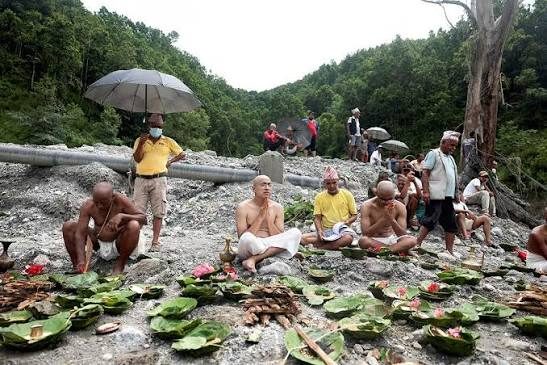
Kathmandu : Families performed the cremation of the victims on Wednesday, a week after the devastating flash floods hit Nepal.
The families used "kush", a sacred grass, to make the effigy.
Additionally, the Nepal Police and rescue team carried the bodies from Dhunche for burial beside a river on the outskirts of Kathmandu, as some bodies could not be identified.
Earlier on Tuesday, mass burial began in the capital, Kathmandu, as well, after the morgue ran out of space after one week of the devastating flood in Nepal.
Security forces donned in Personal Protective Equipment (PPE) carried the body bags and buried them in the Gorkarna forest area on the outskirts of Kathmandu.
Amid the rainfall, the security personnel walking through the muddy forest carried the bodies and buried them with markers on top. The big bags contained the tags through which the bodies would be later exhumed and handed over to families after establishing the identities.
DNA of the buried bodies has already been kept for cross-matching with the family. As the bodies of the victims swept away by the Bhotekoshi flood are being dumped downstream, hospitals are struggling to find places to store and identify them.
The Himalayan Nation only has a capacity of storing about 350 bodies in the morgues nationwide, which has led to a shortage of space to store the bodies until the family identifies and claims them.
The remains of the victims swept by flood from Rasuwa and Nuwakot are being recovered in different parts of the nation.
The district of Chitwan, a major low lying areas has collected the highest number, 321 bodies. The morgues there have already been filled with the bodies of the victims swept downstream, which has prompted authorities to set up temporary facilities.
Authorities are managing the bodies under the Unidentified and Unclaimed Bodies Management Guidelines, 2021, under which a committee headed by the district police chief is responsible for managing the remains.
With morgues running out of space, the government has engaged in managing unidentified bodies by amending the Unidentified and Unclaimed Body Management Guidelines, 2021.