
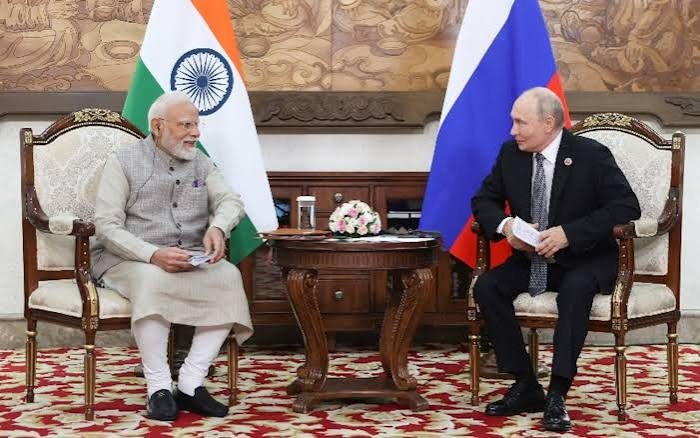
New Delhi : Prime Minister Narendra Modi greets Russian President Vladimir Putin with a hug
Prime Minister Narendra Modi and Russian President Vladimir Putin engaged in comprehensive discussions to bolster bilateral trade, defence, and energy cooperation, while also addressing the ongoing Ukraine conflict and exploring avenues for peace and resolution.
Prime Minister Modi and President Putin held extensive talks to boost the India-Russia strategic partnership, aiming for a USD 100 billion bilateral trade target by 2030.
Key defence cooperation areas discussed included BrahMos missile upgrades, S-400 deliveries, and potential Su-57 fighter jet supply.
Energy ties and civil nuclear cooperation, including plans for new reactors, were significant agenda items, alongside collaboration in critical minerals and industrial sectors.
The leaders addressed the Ukraine conflict, with Putin briefing Modi on the situation and Modi reiterating India's call for dialogue and diplomacy.
Discussions also focused on increasing market access for Indian exporters in Russia to address the trade deficit and enhance the mobility of skilled Indian labourers.
Prime Minister Narendra Modi on Friday held wide-ranging talks with Russian President Vladimir Putin, focusing on enhancing annual bilateral trade to USD 100 billion by 2030 and ramping up existing cooperation in areas such as defence, energy, critical minerals, and fertiliser supplies.
The meeting took place hours after Putin landed in New Delhi on a three-day visit to participate in the high-stakes BRICS summit.
Following the talks, the two leaders travelled in the same car inside the Bharat Mandapam complex to reach the venue of a business forum.
Boosting Bilateral Trade and Investment : It is understood that during the talks, Putin briefed Modi on the overall situation regarding the Ukraine war and ongoing peace initiatives, while Modi reiterated India's position on resolving the conflict through dialogue and diplomacy.
Modi and Putin previously met on the sidelines of the SCO summit in Astana, where the prime minister called for an immediate end to the conflict and urged the Russian leader to shift from an "endless war towards the end of war".
The two leaders also deliberated on ongoing cooperation in trade and investment, energy, and fertiliser security, among other areas.
Ways to boost trade and investment ties dominated the talks, with the Indian side pitching for greater market access for Indian exporters in Russia to address the ballooning trade deficit in Moscow's favour, it is learnt.
The two sides also deliberated on strategies to reach the ambitious bilateral trade target of USD 100 billion by 2030. The current annual trade volume stands at around USD 65 billion.
Deepening Defence and Energy Cooperation
In addition, the two sides delved into expanding their already strong defence cooperation.
Kremlin spokesperson Dmitry Peskov on Tuesday said both sides are exploring BrahMos missile upgrades, adding that Moscow remains committed to fulfilling its remaining S-400 system deliveries and discussing the proposed supply of Su-57 fighter jets.
In the energy sector, the two sides reviewed the overall scenario and agreed to further ramp up cooperation in civil nuclear energy.
Expanding industrial cooperation, collaboration in the rail and tunnelling sectors, developing the steel value chain, and broadening access to the Russian market for Indian exporters also figured in the talks, it is learnt.
Increasing the mobility of skilled Indian labourers to Russia and cooperation in critical minerals were also understood to have been discussed