

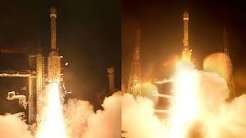
BENGALURU: The GSLV-F17 (Geosynchronous Satellite Launch Vehicle) carrying EOS-05 executed a textbook launch at 2.55 am on Friday.
After setbacks during previous missions, Indian Space Research Organisation (ISRO) teams worked continuously to ensure the mission's success, with the GSLV-F17 placing the EOS-05 satellite into a Sub-Geosynchronous Transfer Orbit at 3.14 am.
Friday's launch marked the space agency's maiden success for the year 2026.
The EOS-05 is India’s first ever imaging satellite to monitor from Geosynchronous orbit about 36,000 km above the Earth.
ISRO teams noted that this is the heaviest satellite ever launched into a geosynchronous orbit, with a lift-off mass of 420.5 tonnes. The 51.7-metre-tall vehicle was launched from the second launch pad of the Satish Dhawan Space Centre in Sriharikota amid light rain.
A beaming ISRO chief V Narayanan said, "I am very happy to announce that the GSLV F-17 vehicle has successfully and precisely injected the advanced EOS-05 geo imaging satellite in the intended and required orbit."
"This is the 107th launch from Srihariharikota and the 19th mission of GSLV," he said soon after the launch.
Narayanan added that this was the second launch of the financial year and the first for ISRO.
Six more launches have been targeted for this financial year, including NVS-03. The teams are also working on the Gaganyaan mission, with the first uncrewed mission under the programme scheduled for launch during this financial year, he said.
Former ISRO directors Dr K Radhakrishnan, K Kiran Kumar and S Somanath were also present at the launch site, along with teams from the Indian Air Force and the Indian Navy.
The GSLV-F17 launch comprised three stages, solid, liquid propulsion and cryogenic. Loud cheers erupted in the launch room when the successful completion of the cryogenic stage was announced by the directors 15 minutes after the launch, overcoming the earlier hiccups faced during the cryogenic stages of previous missions.
The GSLV-F17 has an S139 solid core and four L40H liquid strap-ons. The normal perigee is 172 km and apogee is 29,000 km, but ISRO achieved a 171-km perigee and an apogee of 31,260 km, Narayanan announced on the occasion.
The inclination of the satellite is 19.28 degrees, while the payload mass is 2,367 kg, making it the heaviest satellite launched by India so far, he said.