

At the BRICS Summit in New Delhi, India played a pivotal diplomatic
role by facilitating a crucial meeting between Iranian President
Masoud Pezeshkian and UAE Crown Prince Sheikh Khaled bin Mohamed bin
Zayed Al Nahyan, aiming to de-escalate tensions in the volatile West
Asia region. India facilitated Iran-UAE talks at BRICS Summit.
India successfully brokered a high-level meeting between Iranian
President Pezeshkian and UAE Crown Prince Al Nahyan at the BRICS
Summit in New Delhi.
The diplomatic engagement marks a significant step towards
de-escalation between Iran and the UAE amidst ongoing West Asia
tensions.
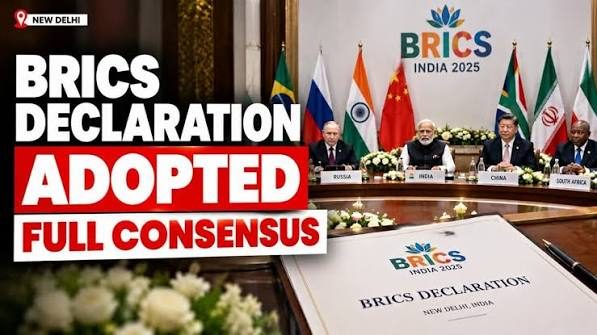
BRICS leaders adopted the New Delhi Declaration 2026, calling for
maximum restraint and protection of civilians in West Asia.
The declaration also expressed serious concern over attacks on
civilian infrastructure and nuclear facilities, urging adherence to
international law.
BRICS emphasised the need for dialogue and diplomacy to achieve
lasting peace and stability in the region, including humanitarian
access in Gaza.
New Delhi on Saturday played peacemaker as Iranian President Masoud
Pezeshkian met the Crown Prince of Abu Dhabi Sheikh Khaled bin Mohamed
bin Zayed Al Nahyan, who represents the United Arab Emirates, on the
sidelines of the BRICS Summit in New Delhi.
The meeting is a diplomatic coup of sorts as the two sides have been
at odds during the ongoing West Asia conflict.
BRICS Calls For Justice And Restraint : During his address to the BRICS Summit the Iranian President had urged the BRICS forum to take practical measures to counter unilateral and inhumane sanctions.
Pezeshkian said BRICS must be a voice for justice.
"BRICS members have a responsibility to stand against the
normalization of attacks on civilian infrastructure and peaceful
nuclear facilities, because any action against these sites constitutes
a direct threat to international peace and security.
The issue of Palestine and upholding the Palestinian people’s right to
self-determination is a serious test of the credibility and legitimacy
of global governance and requires BRICS to play an active role," he
said.
New Delhi Declaration Addresses West Asia Tensions. Earlier, the BRICS bloc unanimously adopted the New Delhi Declaration 2026.
The declaration expressed deep concern over the continued escalation
of tensions in West Asia and called for exercising maximum restraint,
as well as avoiding actions that could further aggravate the
situation.
'We urge to ensure the protection of civilians and civilian
infrastructure in accordance with the purposes and principles of the
Charter of the United Nations in their entirety and
interconnectedness, including respect for the sovereignty and
territorial integrity of the States.
We encourage increasing efforts, through dialogue and diplomacy, towards a long-term understanding that will contribute to lasting peace, security and stability in the region. We stress the need to work together to maintain smooth flow of global trade, supply chains and energy, in accordance with applicable international law,' the declaration read.
'We express serious concern over deliberate attacks on civilian
infrastructure and peaceful nuclear facilities under full safeguards
of the International Atomic Energy Agency (IAEA), in violation of
international law and relevant resolutions of the IAEA.
Nuclear safeguards, safety, and security must always be upheld, including in
armed conflicts, to protect people and the environment from harm,' the
resolution added.
The BRICS bloc also called for the implementation of the relevant UNGA
and UNSC Resolutions and urge all parties to ensure the maintenance of
ceasefire and full and unhindered humanitarian access in the Gaza
Strip.