
New Delhi: Maritime security and artificial intelligence (AI) will be central to India's bid for a non-permanent seat on the UN Security Council for 2028-29, according to the Indian envoy to the United Nations.
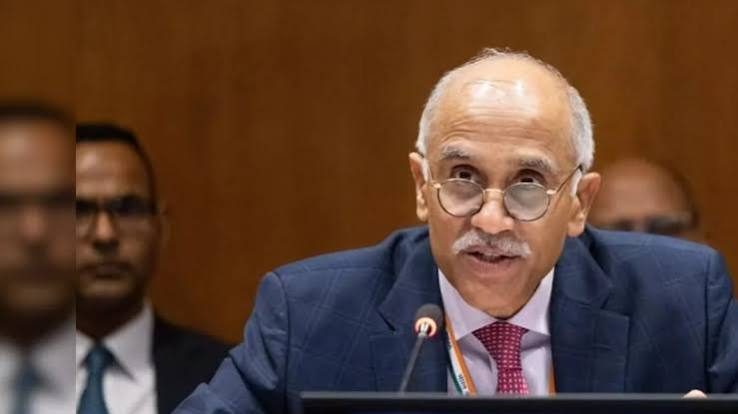
Addressing a high-level debate at the council, India's Permanent Representative to the UN, Ambassador Harish Parvathaneni, emphasised that technology must enhance human security and make shared maritime commons safer, rather than more contested.
India also stressed the need for developing nations to gain access to necessary technology and training to participate in governance.
"India has identified AI (artificial intelligence) and maritime security as important priorities for its candidature to the Security Council for 2028-2029. Our objective is clear: technology must strengthen human security, not undermine it; it must expand opportunity, not inequality; and it must make our shared maritime commons safer, not more contested," Parvathaneni said.
India is contesting the election next year for a non-permanent Council seat with a two-year term starting in 2028, polling for which will be conducted in June next year, where India and Tajikistan will compete for the sole seat in the Asia-Pacific Group category.
The Indian envoy highlighted the threat of cyber vulnerabilities and the importance of safeguarding freedom of navigation against attacks on commercial shipping. He also stressed that technological advances must not deepen existing disparities.
"Developing countries require access to technology, training and institutional capabilities to secure their maritime infrastructure and participate meaningfully in shaping technological governance," Parvathaneni said.
Parvathaneni underscored the need to safeguard freedom of navigation and maritime commerce, saying recent attacks against commercial shipping have demonstrated how disruptions at critical maritime chokepoints can have consequences far beyond their immediate geography.
"They threaten seafarers, disrupt supply chains and disproportionately affect developing countries through higher costs and economic uncertainty," he said, reiterating India's strong condemnation of attacks against commercial vessels.
He recalled that External Affairs Minister S. Jaishankar and Greece's Foreign Minister George Gerapetritis had co-chaired a high-level discussion last month on AI and maritime security and said this was an opportunity to build on it.
The Council debate took place on a day when Iran's Navy said three oil tankers in the Strait of Hormuz had hit sea mines and were ablaze, highlighting the maritime perils.
On the debate topic-- "Emerging Technologies and Maritime Security: Implications for Peace and Security" -- he said, "Emerging technologies are fundamentally transforming the maritime domain," and "equally, their misuse presents new challenges that demand our collective attention."
"AI-enabled analysis of satellite imagery, radar and vessel-tracking data can improve maritime domain awareness and detect suspicious activities," he said.
To enable these solutions, he offered India's cooperation, which he said is "guided by the vision of SAGAR, Security and Growth for All in the Region".
"India's Information Fusion Centre-Indian Ocean Region (IFC-IOR), located near New Delhi, demonstrates the value of cooperation and information-sharing in strengthening maritime security," he said.
"Our approach is guided by the vision of SAGAR -- Security and Growth for All in the Region -- and the broader commitment to inclusive maritime cooperation," he said.
Calling on the international community to address emerging technological vulnerabilities, he said increasing digitalisation and automation also expose ports, vessels, communication networks and undersea infrastructure to cyber threats.
"The proliferation of autonomous systems raises complex questions of attribution, accountability and unintended escalation. We must therefore ensure appropriate safeguards, meaningful human oversight and clear responsibility in the deployment of emerging technologies," he said.