
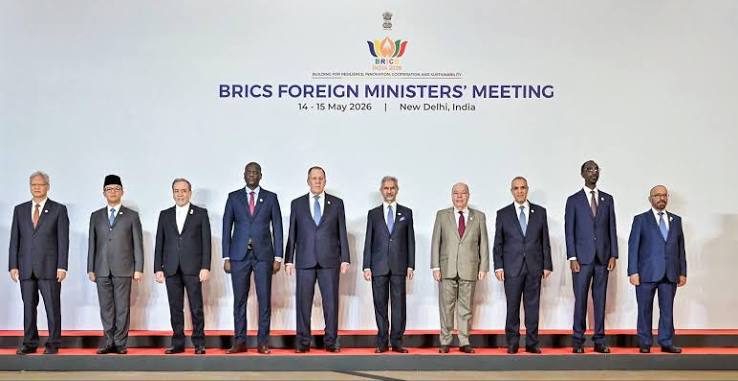
New Delhi : The two-day BRICS summit hosted by India starting Saturday will focus on boosting collective resilience in food, energy, health, disaster
reduction and critical supply chains, positioning the group as an
effective anchor amid a fragmented geopolitical environment.
The summit in New Delhi is taking place against the backdrop of a
global economy facing the adverse impacts of the Russia-Ukraine war,
the West Asia crisis, particularly the blockade of the Strait of
Hormuz, and the Trump administration's trade and tariff policies.
Chinese President Xi Jinping, Iranian President Masoud Pezeshkian,
Russian President Vladimir Putin, South African President Cyril
Ramaphosa and Indonesian President Prabowo Subianto are among the top
leaders expected to attend the meeting.
With just three days left for the summit, it remains unclear whether
the member nations of the grouping have reached consensus on a joint
statement, as differences between Iran and the United Arab Emirates
(UAE) over the West Asia crisis persist.
The grouping operates under a framework of consensus. BRICS,
originally comprising Brazil, Russia, India, China and South Africa,
expanded in 2024 to include Egypt, Ethiopia, Iran, the United Arab
Emirates and Saudi Arabia, with Indonesia joining in 2025.
Belarus, Bolivia, Kazakhstan, Cuba, Malaysia, Nigeria, Thailand,
Uganda, Uzbekistan and Vietnam became BRICS partner countries last
year.
BRICS has emerged as an influential grouping, bringing together 11
major emerging economies that represent around 49.5% of the global
population, around 40% of global GDP and around 26% of global trade.
India's chairship of the grouping has centred on four pillars:
resilience, innovation, cooperation and sustainability.
A view of the national flags of countries participating in the 18th
BRICS Summit hoisted outside the Bharat Mandapam, in New Delhi, on
Wednesday, Sep 09, 2026.
Under the resilience pillar, India has been focusing on strengthening
collective cooperation in areas such as health, agriculture, food,
energy, disaster risk reduction and supply chains, officials said.
Enhancing cooperation in trade, investment, connectivity and high
technology will also be high on the agenda of the summit, they said.
India's BRICS chairship is guided by the theme: 'Building for
Resilience, Innovation, Cooperation and Sustainability', reflecting
its vision of a people-centric approach rooted in the spirit of
"humanity first."
In addition to these areas, the leaders will exchange views on
strengthening intra-BRICS cooperation on common priorities and share
perspectives on global and regional matters of mutual importance,
according to the Ministry of External Affairs.
Under India's chairship this year, over 350 meetings and high-level
engagements have been held in more than 25 cities across the country
to further strengthen the BRICS strategic partnership across three
fundamental pillars: political and security, economic and financial,
and cultural and people-to-people exchanges.
India is a founding member of BRICS and has previously held its
chairship in 2012, 2016 and 2021. India assumed its fourth BRICS
chairship on 1 January 2026.
According to the Ministry of External Affairs (MEA), the summit will
begin at 2.35 pm on Saturday with a closed-door session for BRICS
member countries themed "Inclusive Global Governance and Strengthening
Multilateralism".
Following the session, leaders will tour the "Bharat Innovates
Exhibition", scheduled to open at 4.25 pm. At 5.05 pm, the leaders
will assemble on the lawns of Bharat Mandapam, the summit venue, for a
family photo, followed by a joint tree-planting ceremony.
The first day's engagements will conclude with a gala dinner hosted by
Prime Minister Narendra Modi at 7.30 pm. On Sunday, leaders from BRICS
member states, partner nations and outreach invitees will arrive
starting at 9.55 am, followed by an official group photo at 10.35 am.
The open session, titled "Resilience, Innovation, Cooperation and
Sustainability: Shaping the Future for Inclusive Global Growth", is
scheduled to begin at 10.50 am, according to the schedule released by
the MEA.
The summit will culminate with the release of the New Delhi Declaration.