
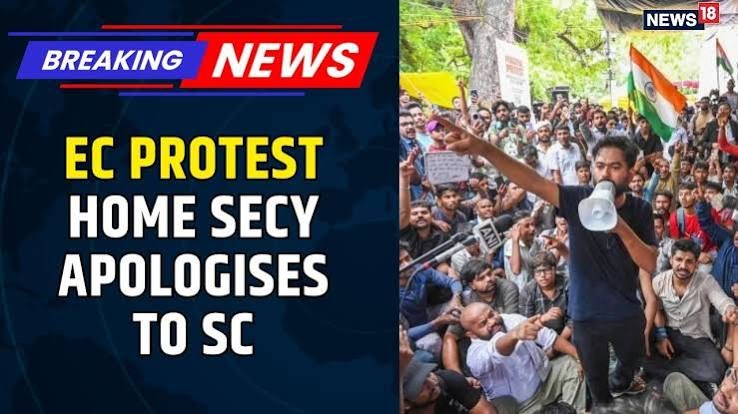
New Delhi : Union Home Secretary Govind Mohan has issued an unconditional apology to the Supreme Court for imposing restrictions in Delhi ahead of an October 10 protest, asserting that the measures were taken to maintain public order and were not a deliberate defiance of the court's directives.
Union Home Secretary Govind Mohan has issued an unconditional apology to the Supreme Court for restrictions imposed in Delhi before an October 10 protest, denying wilful non-compliance.
Mohan stated the restrictions were intended to maintain peace and prevent public order disturbances, citing a protest without permission and past experiences with similar events.
The Supreme Court had previously directed the Centre to regulate services only to the extent necessary to avoid inconveniencing ordinary citizens.
The Delhi Police also filed an affidavit detailing security arrangements, metro restrictions, and traffic management measures, asserting compliance with court directives.
Mobile internet services were restricted within a four-kilometre radius of Raisina Hill from October 9-10, excluding Wi-Fi and broadband, a measure the police deemed proportionate.
Union Home Secretary Govind Mohan has tendered an unconditional and unqualified apology to the Supreme Court over restrictions imposed in Delhi ahead of an October 10 protest, submitting that there was no wilful or deliberate non-compliance with the court's October 9 order.
In a response to a contempt notice, Mohan said the Centre's October 9 communication imposing restrictions was aimed at maintaining peace and preventing any disturbance of public order, citing a proposed protest allegedly planned without requisite permission and the Delhi Police's experience during the July 20 protest over the NEET paper leak.
Supreme Court Directives and Compliance
The Supreme Court had directed the Centre to lift a complete prohibition on certain services and regulate them only to the extent necessary to ensure that ordinary citizens were not inconvenienced.
Mohan said the Delhi Police had sought a one-day suspension of cellular internet services, and the request was processed in accordance with the law and considered proportionate in view of the prevailing situation.
The shutdown remained in effect from 10 pm on October 9 to 10 pm on October 10 within a four-kilometre radius of Raisina Hill.
It applied only to cellular internet services, excluding Wi-Fi and broadband connections.
Mohan sought the discharge of the contempt notice issued against him and requested modification of the Supreme Court's October 11 order to permit internet suspension when necessary, subject to statutory safeguards.
Delhi Police's Affidavit and Measures
Meanwhile, the Delhi Police has filed an affidavit in the Supreme Court detailing security arrangements, metro restrictions and traffic management measures put in place ahead of the October 10 protest.
Delhi Police Commissioner Anurag Kumar stated in the affidavit that the police had taken necessary steps to comply with the court's directives and maintain law and order in sensitive areas.
The police said security arrangements were reviewed in view of the proposed protests at Jantar Mantar and other parts of New Delhi, as well as VVIP movements, diplomatic visits and other major events.
The police had asked the Delhi Metro Rail Corporation (DMRC) to close the entry and exit gates of 45 metro stations from 9 pm on October 9 to 6 pm on October 10 and reduce the frequency of trains, citing concerns over crowds moving towards sensitive areas and the possibility of a law-and-order disruption.
Lifting Restrictions and Ongoing Monitoring
On October 10, the police wrote to the DMRC to lift the restrictions and resume normal train operations from 10 pm, stating that the Supreme Court's directive concerning metro services had been implemented.
The affidavit also detailed traffic diversions introduced on major roads and intersections from 6 am on October 10 and 11.
The police said 88 diversion signboards were installed to manage traffic and commuters were advised to plan their journeys in advance, avoid non-essential travel and follow traffic police updates.
On internet restrictions, the police maintained that services were not disrupted, but said mobile internet services had been restricted in accordance with prescribed regulations in view of law-and-order concerns.
The restrictions were being reviewed based on the prevailing situation.
The police also said no one was illegally detained under the court's directives and that lawyers, journalists and other professionals were not prevented from performing their duties.
Action was taken against those violating orders issued under Section 163 of the Bharatiya Nagarik Suraksha Sanhita (BNSS), the affidavit said, adding that notices under the provision were displayed in designated areas.
Notices around the Supreme Court premises were also reviewed and removed where necessary.
The police said the law-and-order and traffic situation was being continuously monitored and appropriate measures would be taken as required.