
Jaishankar also highlighted the impact of conflicts and global disruptions, saying the “4F” crisis of fuel, food, fertiliser and finance could not be left unaddressed.
External Affairs Minister S Jaishankar during the 'Partners for Multilateralism, International Law, Peace & Prosperity' (P4M) Summit, in New York.
External Affairs Minister S Jaishankar during the 'Partners for Multilateralism, International Law, Peace & Prosperity' (P4M) Summit, in New York.
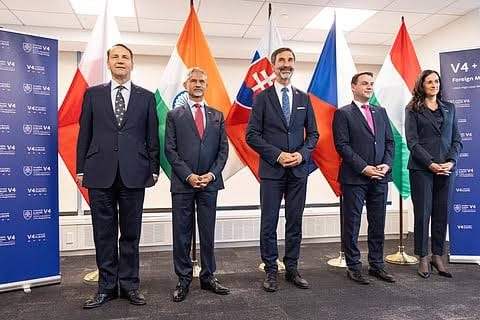
External Affairs Minister S Jaishankar on Monday co-chaired the inaugural ‘Partners for Multilateralism, International Law, Peace & Prosperity’ (P4M) Summit at the UN, with India calling for stronger multilateralism and reforms to make global decision-making more participatory and transparent.
India was among the co-sponsors of the summit, held on the margins of the 81st UN General Assembly session, along with Australia, Barbados, Brazil, Canada, Kenya and the European Union.
“We meet at a time when the global order is under stress,” Jaishankar said, underlining the need for multilateralism to assert itself amid geopolitical tensions, competition and conflicts.
He said a “steady rebalancing” of global power over the past few decades had taken a different turn due to intensifying geopolitical tensions and conflicts.
“If left unchecked, it would call into question the very spirit of international cooperation,” he said, stressing that “reformed multilateralism” was essential.
“More participative deliberations and more transparent decision-making are both overdue,” Jaishankar said.
He also highlighted the impact of conflicts and global disruptions, saying the “4F” crisis of fuel, food, fertiliser and finance could not be left unaddressed. He called for frameworks and safeguards to deal with emerging technologies and risks, as well as diversification of supply chains in the face of potential chokepoint disruptions.
Jaishankar said multilateralism would be strengthened only when international law, rules and norms were consistently observed.
He listed peace and international security, climate action, emerging technologies, development finance, counter-terrorism, supply chains, disaster resilience and pandemic preparedness among issues requiring greater international cooperation.
European Council President Antonio Costa described the summit's co-sponsors as a “wide and diverse” representation of the international community, saying the multilateral system was under stress.
Kenyan President William Ruto said the crisis of multilateralism was also a crisis of rules and institutions that had failed to keep pace with a changing world.
Australian Prime Minister Anthony Albanese said global challenges, including conflicts, inflation and the risks posed by emerging technologies, could not be addressed by countries acting alone.
The summit was also attended by Barbados Prime Minister Mia Mottley, Brazilian Foreign Minister Mauro Vieira and Canadian Permanent Representative David Lametti, who read remarks on behalf of Prime Minister Mark Carney.
The inaugural meeting comes amid divisions within the 15-member UN Security Council, particularly among its five permanent, veto-wielding members — China, France, Russia, the UK and the US — over several major global conflicts.