
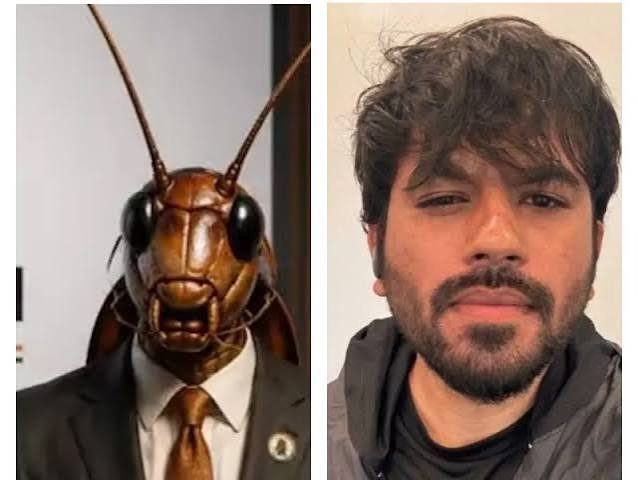
New Delhi: The name may sound unusual, but the political pressure being created by the Cockroach Janata Party (CJP) is getting difficult to ignore. The group, which began as a social media campaign, has spent the past three months trying to influence public issues without contesting elections or claiming to be a conventional political party.
The CJP has gained attention through campaigns on education and institutional decisions. Its next challenge is to turn online support into lasting public action.
It has claimed two major successes: the resignation of Union Education Minister Dharmendra Pradhan following the NEET paper leak controversy and the reversal of a decision by the Bar Council of India (BCI) that had stopped the enrolment of 2026 graduates of NALSAR University of Law.
Now, the CJP has turned its attention to government schools. Its ‘School Theek Karo Abhiyan’ (fix the schools campaign), which was launched on August 15, raises a question about whether the group can continue to influence institutions without entering electoral politics.
From online campaign to pressure group : The CJP came into the spotlight through social media and has used online campaigns to build pressure around issues it believes have been ignored by governments and institutions.
Its recent confrontation with the BCI offers an example of how fast that pressure can build. The BCI directed state bar councils not to enroll NALSAR University of Law’s 2026 graduating batch as advocates after some students opposed the invitation extended to Chief Justice of India Surya Kant to attend the university’s convocation.
The decision brought BCI Chairman Manan Kumar Mishra under intense scrutiny on social media. CJP founder Abhijit Dipke questioned whether the time had come to demand Mishra's resignation. "Is it time to demand Manan Mishra's resignation?" he asked.
Following the social media pressure, Mishra first withdrew the notification and later apologised to the students.
Chief Justice of India Justice Suryakant also criticised the BCI, describing the matter as being between the institution and its students and questioning the BCI's intervention.
The speed with which the BCI chairman changed his position strengthened CJP's claim that its social media campaigns can put pressure on powerful institutions. That appears to be the group's biggest strength at this stage.
CJP's latest campaign targets government schools, an issue that affects millions of families but often receives less political attention than political controversies.
CJP spokesperson Ashutosh Ranka said the group would continue working as a pressure group rather than immediately turning itself into a political party. Talking to the media, he said the group want people to lead the campaign.
“We are starting the ‘School Theek Karo Abhiyan’ from August 15. We will not allow our children to be deprived of proper schools. And this is ‘Jantar Mantar Season Two’," he said.
He added, "We want the people of this country to lead this campaign. Government schools have been ignored since independence. Children living in villages have deliberately been deprived of education. Around 94,000 schools have been closed in the country in the last few years. This appears to be an attempt by the government to keep the country's children powerless."
Since the campaign began, the CJP has been posting videos showing the condition of government schools in different parts of the country. After launching the campaign, Dipke posted a video on X from a village where he had attended an Independence Day flag-hoisting ceremony.
"I had the opportunity to come to the village and hoist the national flag. I am very proud of that, but I am also saddened to see the condition of the government school here. Even after 80 years of independence, we have not been able to provide good schools for our children," he wrote.
Are schools really disappearing? : CJP's campaign comes against the backdrop of a decline in the total number of schools in India over the past decade. Data from the Unified District Information System for Education Plus shows that the number of schools increased from 15.16 lakh in 2014-15 to 15.58 lakh in 2017-18.
The trend changed after 2018-19. By 2022-23, the number had fallen to 14.66 lakh, around 92,000 fewer than in 2017-18.
There was a small increase in 2023-24, but the total stood at around 14.71 lakh in 2024-25, still well below the 2017-18 level.
The fall in the number of schools does not necessarily mean that children have lost access to education. School mergers, the consolidation of schools with low enrolment and efforts to use available resources more efficiently are among the reasons behind the decline.
But the numbers give the CJP an issue that can be taken directly to the public, particularly through images and videos showing poor facilities.
Why the campaign is getting attention : Senior journalist Hemant Atri believes the CJP is presently performing a role that civil society groups traditionally played. "Civil society's role is what the CJP presently appears to be taking on," he said.
He believes the group's Jantar Mantar protest helped establish its credibility. "It has to be acknowledged that the first Jantar Mantar movement strengthened the CJP's credibility. There is no doubt about that. And now, the way they are taking up issues such as the facilities available in schools and auditing them is also a very good initiative," he added.
Senior journalist and political analyst Sharad Gupta also sees value in the school campaign. "CJP's ‘School Theek Karo’ campaign is showing the real condition of schools. In some places, toilets are broken. In others, there is no drinking water. In the mid-day meal, there is water instead of dal (pulses). The condition of schools is genuinely very poor," he said.
He added, "If nearly 1 lakh government schools have closed in the last 10 years, what is the condition of the remaining schools? Why are these schools closing?"
Atri believes that CJP's attention to education could help it connect with people who feel that mainstream politics has overlooked everyday issues.
"The biggest thing is that the CJP is not so far a political party. Its space is virtual. But in that virtual space, there was a vacuum for young people who wanted a platform, and they have filled that vacuum to some extent," he said.
He said education is one of the most neglected areas. “Whether at the district level or the block level, the condition of schools has been poor," he said.
Is CJP taking up issues the Opposition has overlooked? : The group's rising presence also raises another question about whether the CJP is taking up political space that Opposition parties have failed to use effectively.
Gupta argues that problems affecting ordinary people should be raised by political parties, particularly those in the Opposition. But he says electoral politics often changes those priorities.
"Problems affecting ordinary people should be raised by every political party, especially the opposition. But what happens is that you are in the opposition today and in power tomorrow. The party that is in power today may be in the opposition tomorrow. So nobody has a real interest in improving people's lives. Political parties are interested only in gaining power," he explained.
The CJP presently has an advantage that established opposition parties do not. "The CJP is not in the race for power and has nothing to lose. There are no cases against them so far. They do not have to face the fear of the ED and CBI in the way the opposition does," he said.
That freedom allows the group to take positions without immediately having to defend an electoral record or worry about retaining power. But that advantage could disappear if the CJP decides to become a political party.
If CJP becomes a party, everything changes : Gupta believes that the biggest challenge may come if the CJP moves beyond pressure politics. "The day they become a political party, their interests will change. Then people will have to ask whether the CJP can bring about a change in the system or whether it too will simply become part of the race to change who is in power," he said.
This leaves the CJP facing a difficult choice about its future. As a pressure group, it can focus on individual issues, build online campaigns and demand answers without having to present a complete political programme.
It can also criticise both the government and opposition-ruled states over the condition of schools. A political party would also have to answer tougher questions about who would govern, how policies would be funded, who would contest elections and how it would respond when its own decisions come under scrutiny.
At this stage, CJP appears determined to avoid becoming a political party. Its school campaign suggests that it wants to test how far public pressure can go before electoral politics becomes necessary.
Can CJP keep the momentum going? The CJP has managed to create attention around two major controversies in a relatively short period. The BCI episode showed that its campaigns can produce a fast response from an institution, while the NEET controversy helped build its public profile.
But individual victories are different from sustained political influence. A school campaign will require the CJP to move beyond viral posts and document problems consistently across districts, follow up with authorities and show whether its pressure produces measurable changes.
ALSO READ: From US-returnee to CJP leader: How Abhijeet Dipke built a 37-day Gen Z movement that forced Dharmendra Pradhan's resignation
That is where its experiment as a pressure group will face its difficult test. Atri believes the group has handled the challenges it has faced so far. "So far, whatever challenges the CJP has faced, it has dealt with them effectively," he said.
The question is whether it can do the same with an issue as large and complicated as India's government school system.
The Cockroach Janata Party may have started as an internet-driven political experiment. Its next phase will show whether it can turn online anger into lasting public action without becoming just another political party.