
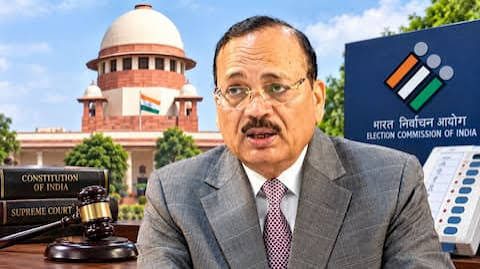
New Delhi : CJI Surya Kant agreed to examine a plea seeking to recall an SC order on the CEC appointment law.
The Supreme Court is set to decide whether it should reconsider an earlier order that could send the challenge to India’s election commissioner appointment law to a five-judge bench. Chief Justice of India Surya Kant said on Wednesday that he would examine a fresh plea and decide what should happen next.
"We will examine and take a call," the CJI said after senior advocate Gopal Sankaranarayanan asked for an urgent hearing.
What is the new plea about?
The application has been filed by Naman Sherstra, one of the petitioners challenging the Chief Election Commissioner and Other Election Commissioners Act, 2023.
The case is about the law that decides how the Chief Election Commissioner and Election Commissioners are appointed.
Sherstra has asked the Supreme Court to recall part of its September 23 order. That order followed a difference of opinion between Justices Dipankar Datta and Satish Chandra Sharma over whether the case should be heard by a five-judge Constitution Bench.
Justice Datta said a larger bench was not needed because the case could be decided using legal principles already laid down by the Supreme Court. Justice Sharma took a different view and said the case involved important questions about the Constitution that should be heard by at least five judges.
Because the two judges disagreed, the matter was sent to the Chief Justice of India to decide whether a Constitution Bench should be formed.
Why does the petitioner want part of the order recalled?
The new application focuses on Justice Sharma’s role in the case. The petitioner says Justice Sharma’s son appears as a lawyer for the Election Commission of India before the Madhya Pradesh High Court.
According to the plea, this fact was not disclosed while the Supreme Court was hearing the case.
The petitioner says the case was heard on May 6, May 7, May 14, May 27 and July 30. On July 30, the bench reserved its order on whether the matter should go to a larger bench.
The application says the petitioners learned about Justice Sharma's son's professional link with the Election Commission only after the September 23 order was delivered.
It states, "The question is whether the established circumstances, viewed objectively, give rise to a reasonable apprehension concerning impartiality."
The plea also says, "The absence of disclosure deprived the petitioners of an opportunity to raise that request before the opinions and order dated September 23 were pronounced."
The application does not accuse Justice Sharma of actual bias. It argues that the petitioners should have been told about the connection so they could decide whether to seek his recusal from the case.
What exactly does the petitioner want recalled?
The petitioner is not asking the Supreme Court to cancel Justice Datta's opinion. The request is limited to Justice Sharma’s opinion and the common order that sent the matter to the CJI for possible placement before a five-judge bench.
Sankaranarayanan told the CJI that the recall plea had earlier been mentioned before Justice Datta. Justice Datta did not take it up and asked the petitioner to approach the Chief Justice instead.
The Supreme Court was also told that another petitioner has filed a separate curative petition. Sankaranarayanan said that petition could be dealt with separately and that the present application was specifically asking for recall of the earlier order.
Why is the CEC appointment law being challenged?
The main case concerns the 2023 law on the appointment of the Chief Election Commissioner and Election Commissioners.
In March 2023, a five-judge Supreme Court bench had said that, until Parliament made a law, appointments should be made on the advice of a committee consisting of the Prime Minister, the Leader of the Opposition in the Lok Sabha and the Chief Justice of India.
Parliament later passed a law creating a different selection committee. Under the 2023 law, the panel includes the Prime Minister, the Leader of the Opposition and a Union Cabinet minister chosen by the Prime Minister. The Chief Justice of India is not part of that committee.
That change is now under challenge before the Supreme Court.
What happens next?
The Supreme Court has not yet decided whether the 2023 appointment law is constitutional. For now, the immediate question is whether the recall application should be heard before the CJI decides if the main case should go to a five-judge bench. CJI Surya Kant has said he will examine the request and take a decision.