
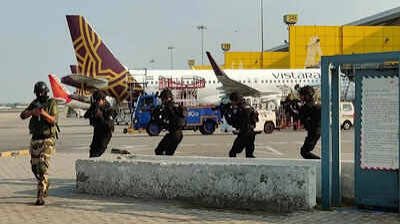
Mumbai : Central Industrial Security Force (CISF) deployment across Indian airports is set to decline by 10% or more in phases as private security agencies take over non-armed roles under new norms issued by the Bureau of Civil Aviation Security (BCAS).
CISF deployment at airports to drop as private security staff take over non-armed duties under new BCAS norms.
The Central Industrial Security Force (CISF) will see an eventual withdrawal of personnel from Indian airport terminals as private security firms take over functions that do not involve firearms in accordance with the recently updated guidelines of the Bureau of Civil Aviation Security (BCAS).
The guidelines have been approved by the Ministry of Civil Aviation (MoCA) and distributed to concerned parties following orders laid down on October 27, 2023.
It should be noted that the process is gradual and aims to optimise security personnel placement while ensuring that sensitive armed operations remain under the CISF's jurisdiction.
Why has the government decided to outsource duties to private companies?
The recommendations to take such steps come after a thorough assessment that involved all airport operators, the Intelligence Bureau, the CISF, and the Ministries of Home Affairs and Civil Aviation was conducted throughout the previous year.
Those familiar with the events state that the government wants to decrease operational costs and prevent increases in airfares.
Avoiding increases in Passenger Service Fees (PSF): The expenses related to the deployment of CISF are completely funded from the PSF collected from passengers.
Being an official, they commented that the government aims to abstain from increasing the PSF, as demand is not strong enough, ticket prices are high, and fuel prices are very high too.
Preserving basic armed security services: CISF will still provide security to highly protected places, including perimeter armed security, patrolling, surveillance and intelligence, quick response team (QRT), and other important parts of aviation.
Monitoring and training from the CISF: After being recruited, the private security personnel come under the direct control of CISF Chief Airport Security Officer (CASO) and get a full training and management from the CISF.
Plan for hiring people: Current situation at DigiYatra lanes, cargo and reserve ratios.
At present, the CISF is in charge of 74 out of 119 working airports in India and 45 airports secures by the state police. Some of the most important airports, namely Delhi and Mumbai, use hired security personnel for patrolling the non-strategic objects.
The directive, sent to BCAS on October 27, established some necessary requirements regarding the manpower:
DigiYatra lane operation: For each DigiYatra lane, there will be an assistant along with an Assistant Sub-Inspector supervising each six lanes.
Reserve personnel limits: As per the guidelines, there must be a 28% reserve of CISF personnel and 14% reserve of state police personnel in addition to the prescribed supervisory officer ratios.
Access of vehicles and goods: Separate staffing requirements are there for vehicle access based on whether the X-ray baggage inspection system is operational or not, along with the norms regarding access at cargo terminals.
Three-tier classification of airports and future audit
To facilitate proper deployment, BCAS has divided the airports in India into three classes with respect to monthly number of passengers and flights:
Auditing teams of BCAS and the airport operators will conduct audits for each airport, taking into consideration the terminal facilities as well as passenger traffic by the end of the month.
Officials estimate that final CISF deployment requirements could drop by 10% or more across airports once the Ministry of Civil Aviation reviews the surveys and the Ministry of Home Affairs grants final approval.