

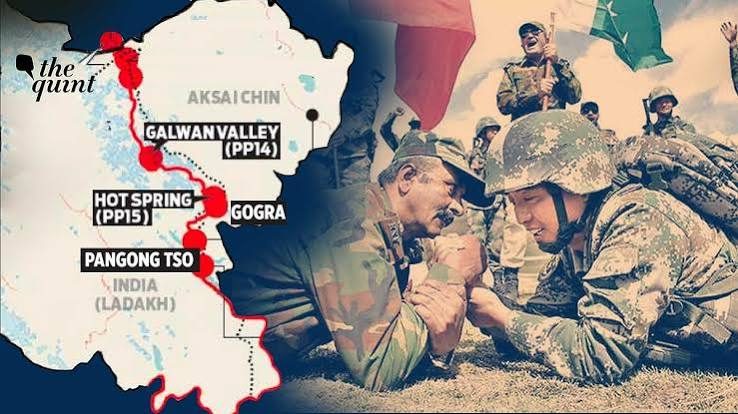
New Delhi : India asserts that peace and tranquility along the Line of Actual Control are vital for bilateral relations, even as Chinese forces continue to disturb the border by diverging from established patrolling patterns, prompting ongoing diplomatic and military engagements.
A view of the mountains near the Line of Actual Control
India stated on Friday that the situation along the Line of Actual Control (LAC) is disturbed when Chinese forces deviate from established patrolling patterns.
External Affairs Ministry spokesperson Randhir Jaiswal emphasised that maintaining peace and tranquillity in border areas is essential for overall bilateral relations.
ITBP Director General Shatrujeet Kapur noted on Thursday that confrontations with Chinese troops continue in Arunachal Pradesh and mentioned new ITBP measures for border management.
India and China continue to use existing diplomatic and military mechanisms to resolve outstanding issues and have agreed to discuss ways to improve understanding of the LAC.
Recent high-level talks between PM Modi and President Xi Jinping, including in October 2024 and last month, have focused on rebuilding trust and respect following the 2020 Galwan clashes.
India on Friday said the situation along the Line of Actual Control (LAC) is disturbed from time to time when Chinese forces diverge from established patrolling patterns, asserting that the maintenance of peace and tranquillity in the border areas is essential for the overall development of bilateral relations.
India's Stance on Border Tranquillity
The remarks by External Affairs Ministry spokesperson Randhir Jaiswal came in response to a question on comments by Indo-Tibetan Border Police (ITBP) director general Shatrujeet Kapur that confrontations with Chinese troops continue to take place in a number of sites along the border in Arunachal Pradesh.
"As we have noted in the past, the situation in the India-China border areas gets disturbed from time to time when Chinese forces diverge from established patrolling patterns," Jaiswal said at his bi-weekly media briefing.
"Both sides continue to use existing diplomatic and military mechanisms to resolve outstanding issues and avoid misunderstanding and miscalculation along the Line of Actual Control (LAC)," he said.
Jaiswal said the two sides have also agreed to discuss ways to improve understanding of LAC in appropriate areas for better border management.
"I would also like to emphasise that the maintenance of peace and tranquillity in the border areas is essential for the overall development of bilateral relations," he said.
ITBP Preparedness and Diplomatic Mechanisms
In his remarks in Rajasthan's Alwar on Thursday, the ITBP director general also said that his force has raised drone platoons in all its border units and prepared a new 'Strike' course to better handle Galwan-like battles.
India and China rolled out a series of measures in the last over one year to rebuild their relationship after it came under severe strain following the deadly Galwan Valley clashes in 2020 and the subsequent military face-off that lasted for over four years.
In October 2024, the two sides firmed up a disengagement pact for Depsang and Demchok, the last two friction points in eastern Ladakh.
High-Level Dialogue to Rebuild India-China Ties
Days after the agreement was finalised, Prime Minister Narendra Modi and Chinese President Xi Jinping held talks in Kazan and took a number of decisions to improve the ties.
In August last year, Modi travelled to the Chinese city of Tianjin to attend the annual SCO summit. Modi and Xi held extensive talks on the sidelines of the SCO (Shanghai Cooperation Organisation) summit.
In the meeting, Modi said India is committed to taking forward its ties with China based on mutual trust, respect and sensitivity.
Last month, Modi held bilateral talks with Xi on the margins of the BRICS summit in New Delhi.
In the talks, Modi stressed that both sides must show sensitivity to each other's core issues and let relations be guided by the "three mutuals" -- mutual respect, mutual sensitivity, and mutual interest.