
New Delhi / New York : India achieved a significant diplomatic victory by successfully steering the BRICS grouping to adopt a crucial joint declaration,
overcoming sharp divisions and emphasising the Global South's pivotal
role in future technologies and global governance.
Prime Minister proposes the Delhi Declaration at the BRICS inaugural
session, New Delhi, September 12, 2026.
India successfully steered the BRICS grouping to adopt a crucial joint
declaration, overcoming significant diplomatic hurdles, particularly
divisions between Iran and the UAE.
The declaration emphasises the Global South's role in shaping future
technologies and global governance, advocating for equal
participation.
BRICS leaders endorsed New Delhi's position to end the West Asia
conflict through 'dialogue and diplomacy' and called for maximum
restraint.
The grouping fully backed India's call for zero tolerance towards
terrorism, condemning the Pahalgam terror attack and rejecting double
standards.
BRICS also criticised trade-restrictive actions inconsistent with WTO
rules, including unilateral tariffs and protectionism under
environmental pretexts.
In a major diplomatic victory for India, the BRICS grouping adopted a
consensus joint declaration on Saturday after overcoming sharp
divisions between the United Arab Emirates and Tehran regarding the
West Asia conflict while notably omitting direct mention of the US for
its attacks on Iran.
The BRICS leaders appeared to endorse New Delhi's position to end the
conflict through "dialogue and diplomacy" and stressed the need to
work together to maintain a smooth flow of global trade, supply chains
and energy, in accordance with "applicable" international law.
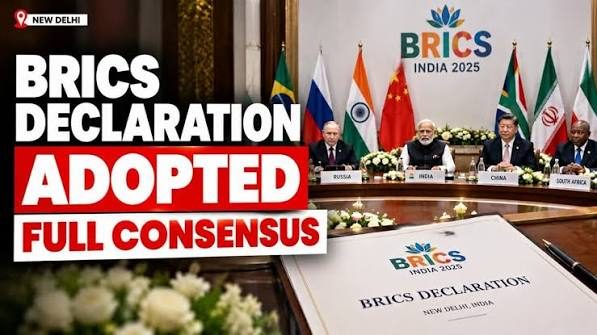
Diplomatic Breakthrough and Consensus : Adopted on the opening day of the two-day summit, the BRICS
declaration is seen as a major triumph for Indian diplomacy.
The negotiations on the text of the declaration went down to the wire as both Iran and the UAE had hardened their positions initially. BRICS is a consensus-based grouping, meaning any single member can block a final joint declaration.
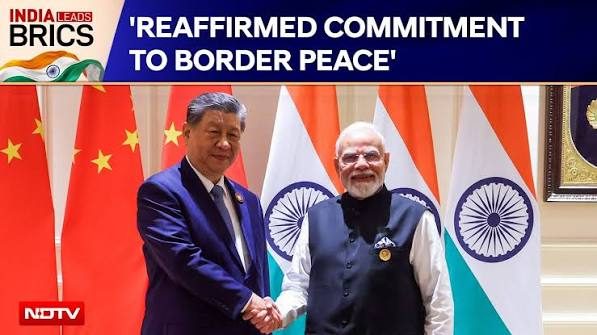
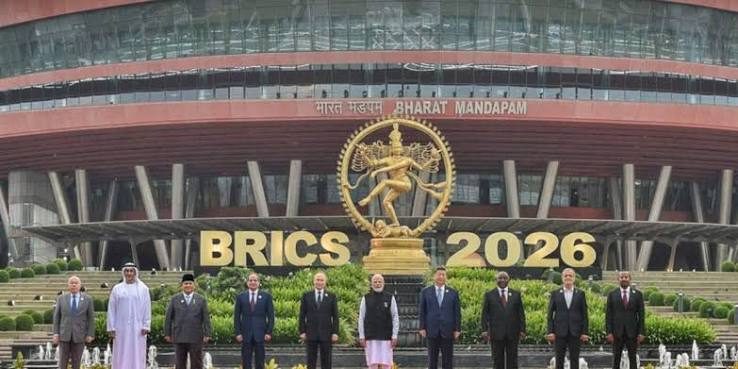
Prime Minister Narendra Modi announced the adoption of the declaration
at the end of the opening day's deliberations in the presence of
Chinese President Xi Jinping, Russian President Vladimir Putin,
Iranian President Masoud Pezeshkian, Abu Dhabi Crown Prince Mohamed
bin Zayed Al Nahyan and other top leaders of the bloc.
Addressing West Asia Tensions
"We express deep concern over the continued escalation of tensions in
West Asia and, recalling our respective national positions, call for
exercising maximum restraint, as well as avoiding actions that could
further aggravate the situation," the declaration said.
"Furthermore, we urge to ensure the protection of civilians and
civilian infrastructure in accordance with the purposes and principles
of the Charter of the United Nations in their entirety and
interconnectedness, including respect for the sovereignty and
territorial integrity of the States," it said.
"We encourage increasing efforts, through dialogue and diplomacy,
towards a long-term understanding that will contribute to lasting
peace, security and stability in the region," it added.
The BRICS stressed the need to work together to maintain a smooth flow
of global trade, supply chains and energy, in accordance with
applicable international law.
The grouping also expressed "deep concern" over the continued violence
in Gaza despite the ceasefire agreement of October last year.
"We call for halting any policies aimed at forced displacement of
Palestinians from Gaza Strip and express concern regarding
arrangements that may prejudice the inalienable rights of the
Palestinian people and legitimise or prolong occupation," it said.
"We reaffirm that a just and lasting solution to the
Israeli-Palestinian conflict can only be achieved by peaceful means
and depends on the fulfilment of the legitimate rights of the
Palestinian people, including the rights to self-determination and
return," it said.
Combating Terrorism and Trade Protectionism
The BRICS also fully backed India's call for zero tolerance towards
any form of terrorism and shunning double standards in countering the
menace, as the top leaders of the influential grouping agreed to have
a concerted approach in dealing with the challenge.
The grouping also condemned in the "strongest terms" the Pahalgam
terror attack in Jammu and Kashmir last year that killed 26 people.
"We reaffirm our commitment to combating terrorism in all its forms
and manifestations, including the cross-border movement of terrorists,
terrorism financing and safe havens," it said.
"We reiterate that terrorism should not be associated with any
religion, nationality, civilisation or ethnic group and that all those
involved in terrorist activities and their support must be held
accountable and brought to justice in accordance with relevant
national and international law," it said.
"We urge to ensure zero tolerance for terrorism and reject double
standards in countering terrorism," it added.
The BRICS emphasised that it is the primary responsibility of states
in combating terrorism and that global efforts to prevent and counter
terrorist threats must fully comply with their obligations under
international law, including the Charter of the UN.
"We condemn in the strongest terms the terrorist attack in Jammu and
Kashmir on April 22, 2025, during which 26 people were killed and many
more injured," it said.
The grouping also criticised the proliferation of "trade-restrictive
actions that are inconsistent with WTO rules, whether in the form of
indiscriminate rise in tariffs and non-tariff measures, or
protectionism under the guise of environmental objectives."
"We voice serious concerns about the rise of unilateral tariff and
non-tariff measures which distort trade and are inconsistent with WTO
rules," it said.