

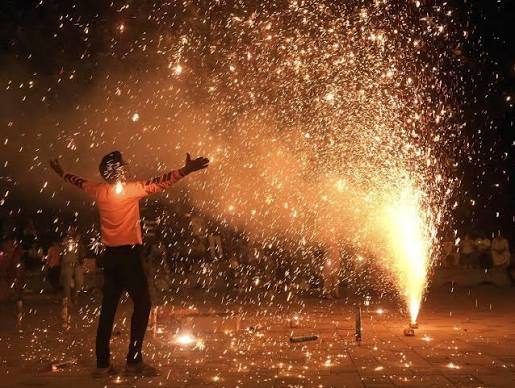
Mumbai : The Bombay high court has issued a landmark ruling, completely banning firecrackers on public roads and restricting loudspeakers during festivals to combat severe noise and air pollution, urging a balance between religious celebrations and environmental responsibility.
Bombay high court orders a complete ban on firecrackers on public roads. Use of loudspeakers, DJs, and laser beams during religious processions deemed "unwarranted."
Court emphasises that festivals must balance religious sentiments with public safety and environmental concerns.
Authorities directed to strictly enforce noise decibel levels and act against violators. Court suggests hefty security deposits for procession permissions to deter violations.
Festivals can be celebrated without causing noise and air pollution, the Bombay high court said on Tuesday while ordering a complete ban on the bursting of firecrackers on public roads.
Passing the order amid the Ganesh festival, a bench of Justices Girish Kulkarni and Neela Gokhale also said that the use of loudspeakers, DJs and laser beams during religious processions was "completely unwarranted".
"Are we going to get additional blessings from God by using all these loudspeakers and firecrackers? As a responsible society, we should put an end to all this. Take the Wari procession (pilgrimage on foot to Pandharpur) for example. It is carried out so peacefully with absolutely no loudspeakers or noise," the HC said.
Court's Stance On Pollution And Public Safety
The court had on Monday taken suo motu (on its own) cognizance of the issue of severe noise and air pollution caused during processions. Bursting of firecrackers on roads is not only dangerous but also causes toxic pollution, the court noted.
"There cannot be firecrackers absolutely. Why should firecrackers even be permitted on public roads in a city like Mumbai. This is the time air pollution starts in Mumbai and a haze sets in. This needs to be stopped. Day or night, on public roads firecrackers cannot be burst," the court said.
Enforcement Challenges And Judicial Directives
Advocate General Milind Sathe, appearing for the Maharashtra government, said Mumbai Police have passed an order banning, between September 9 to September 26, assembly of more than five persons without permission. A complete ban on firecrackers and loudspeakers too is in place, he said. But the court asked if the order was being enforced.
"It is only good on paper. The breaches and violations are apparent," it said.
They would pass an order banning the use of firecrackers on public roads henceforth and direct authorities to take all steps to control noise decibel levels during processions and act against the violators, the judges said.
Deterrents And Balancing Act For Festivals
"All venues and processions that have taken permission from the police shall display the same prominently. This will apply to all festivals," the court said. It also suggested that the government may demand a hefty security deposit when permissions are sought for processions.
"There is no dearth of money for these pandals (where community Ganesh idols are installed). If there is any violation, then the amount will be forfeited. This will act as a deterrent," the HC said.
The bench clarified that it was not against any festival or celebration per se, but it cannot be at the cost of violation of rules and nuisance caused to citizens.
Religious sentiments must be balanced with public safety and environmental concerns, the HC said, adding that celebrations cannot be carried out at the cost of someone's life or health.
Call For Self-Restraint And Regulation
"Citizens cannot be silent sufferers. Why can't celebrations happen in a manner in which no noise pollution occurs. Simultaneously several processions go on and then imagine the noise. This is completely unwarranted," the court remarked.
Urging people to have self-restraint, the court noted that Mumbai is already facing several issues.
"Let them have their celebrations. We have nothing against these celebrations but there has to be regulation and strict adherence to the rules and norms. At present there is absolutely no regulation," the bench said.
The state government cannot express helplessness in this matter, the judge said. While laws are in place, the issue is their strict implementation, it said.
"Right now, the impression among people is that there is no restriction. That needs to be changed," the bench said.