
Lucknow : In a state of more than 240 million people, a lower crime rate is never just a statistical achievement; it is the accumulated result of thousands of ordinary decisions about who is watched, who is protected and which risks are treated as urgent.
The latest NCRB figures for 2024 place Uttar Pradesh’s cognizable crime rate at 180.2 cases per lakh population against the national average of 252.3.
That gap is real, yet it only begins to describe the wider task the police now carry. Women’s safety in public spaces, the protection of children and the elderly, the management of religious congregations, the containment of cyber fraud, and the security of expanding industrial corridors have all been pulled inside the same operational frame.
The question is no longer whether conventional law and order has improved; it is whether the same apparatus can hold these newer and older obligations together without leaving important categories of risk behind.
The first cluster of responsibilities prevention of everyday crime, investigation of organised networks, and action against drug trafficking and smuggling remains foundational. Flag marches during sensitive periods, targeted action against ganja and arms networks, and sustained pressure on inter-district syndicates illustrate routine enforcement.
These measures do not by themselves produce the lower crime rate; they do, however, reduce the space in which habitual offenders and organised groups operate. When such groups are constrained, the residual burden on ordinary policing declines, allowing greater attention to other spheres.
The same logic of rapid, coordinated response appears in the state’s Dial 112 system, which has reduced average response times from earlier figures of 25–30 minutes to around 6.5–7 minutes statewide, supported by a fleet of roughly 6,278 Police Response Vehicles and real-time GPS dispatch.
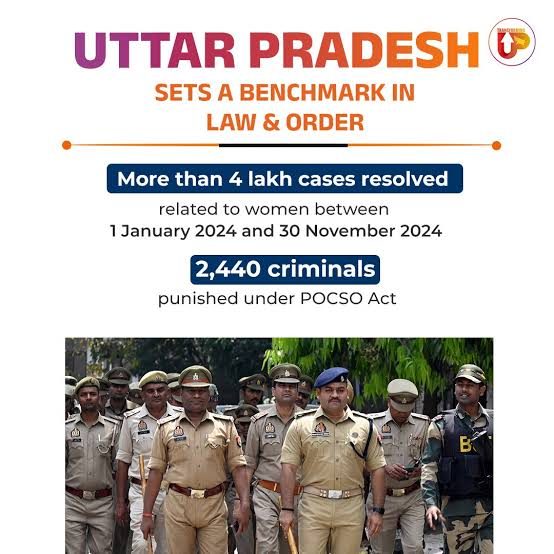
A second set of obligations concerns the differential exposure of particular sections of the population. Women’s safety has received the most visible institutional response. Mission Shakti, launched in October 2020 and now in its fifth phase, has reached over 9 crore women through multi-department coordination.
The Women’s Helpline 1090 has handled 7.78 lakh cases, One Stop Centres have supported 2.10 lakh cases of violence or abuse, and the initiative has prevented more than 1,700 potential child marriages while contributing to the prosecution of 27,425 cases involving women and minors.
After Mission Shakti Centres were established in police stations, a three-month review recorded roughly a 34 per cent drop in rape cases, a 17 per cent drop in kidnapping of women and girls, a 13 per cent drop in dowry deaths and a 10 per cent drop in domestic violence.
Pink booths, expanded women police personnel (from around 10,000 before 2017 to over 44,000) and Anti-Romeo Squads form part of the same architecture.
Parallel attention is required for children, senior citizens, Scheduled Castes and other marginalised communities, and migrant or industrial labour. Each faces distinct risks; a uniform crime-rate decline does not automatically guarantee equal protection.
Religious processions, festivals and major pilgrimage events impose a distinct security load. Flag marches ahead of Holi and Ramzan, crowd-management arrangements for the Kanwar Yatra or Kumbh-related movements, and continuous monitoring of sensitive localities form part of the standing requirement to prevent escalation without suppressing lawful assembly.
In a state that hosts some of the country’s largest religious congregations, the capacity to manage these events without major communal disturbance is itself a measurable public good.
Cybercrime recorded 11,073 cases in 2024. The figure is modest relative to population, yet the trajectory is upward. The Cyber Crime Headquarters in Lucknow has established a 24x7 Cyber Fraud Mitigation Centre the first of its kind in the country which has frozen over Rs 12.5 crore belonging to 221 victims through real-time coordination with banks.
District-level cyber police stations, expanded 1930 helpline capacity, cyber help desks at police stations and a Cabinet-approved Rs 104.28 crore Uttar Pradesh Cyber Security Operations Centre (implemented with IIT Kanpur) mark a shift from purely reactive investigation toward faster financial intervention and infrastructure protection.
Parallel demands arise from counter-terrorism intelligence and the containment of misinformation that can convert online agitation into street disorder.
As industrial corridors, logistics hubs and commercial centres expand, the police are increasingly required to secure factories, warehouses, critical infrastructure and public assets against theft, extortion and sabotage. Financial crimes further enlarge the portfolio.
Improved law and order has created a more predictable environment for industry; the NCRB aggregates do not directly test that claim, but they are consistent with a reduction in the ambient risk that investors and ordinary businesses otherwise price into their decisions.
Rural land disputes, urban density, inter-state border movement, highway safety and disaster response constitute a further layer. Foot patrols in sensitive villages, random checking on expressways, and coordination with disaster-response agencies during floods illustrate the geographical spread of routine work.
None of these activities registers prominently in headline crime statistics, yet each shapes the practical experience of safety for large numbers of citizens.
Underlying all external spheres is the police organisation’s own functioning: recruitment and training standards, forensic and surveillance infrastructure, grievance redressal, accountability mechanisms, and personnel welfare.
Technology-enabled command centres, expanded CCTV networks and faster chargesheeting rates are visible signs of modernisation. Their durability depends on whether the same systems can also address internal issues. Without that internal discipline, gains in any external category remain fragile.
The NCRB data therefore support a qualified assessment. Uttar Pradesh’s lower overall crime rate and improved chargesheeting performance indicate measurable progress in conventional law enforcement.
The expansion of Mission Shakti, Dial 112’s shortened response times, the Cyber Fraud Mitigation Centre’s real-time fund freezing and technology-driven surveillance has enlarged the state’s security framework beyond earlier, narrower conceptions of order.
Whether that enlargement produces durable, evenly distributed reductions in risk will depend on the consistency with which the newer instruments are applied and on the continued willingness to treat remaining category-wise shortfalls as administrative priorities rather than residual anomalies.