
New Delhi : Everybody is on their toes, wondering what to do. Nobody knows what will happen.
'The Bangladesh government has made Sheikh Hasina a factor in India's diplomatic engagement, saying that if India continues to harbour her, bilateral relations will be jeopardised.'
One issue -- Hasina's presence -- can not become a parameter for the entire relationship.
Hasina is also putting pressure on India, as the host country, to take a proactive position. That is why I think India is keen for Prime Minister Tarique Rahman to visit Delhi and have a discussion.'
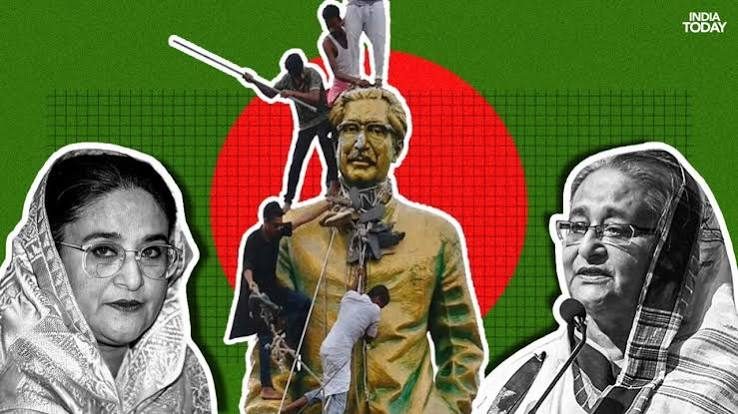
Ousted Bangladesh prime minister Sheikh Hasina who fled Dhaka after an uprising overthrew her government two years ago, and remains in exile in India, made a surprise announcement on August 5, 2026, declaring her intention to return.
She said she is ready to face a trial if the trial is conducted by international standards. By doing this she has created pressure on the Bangladesh government," says senior Indian journalist MA Mujeeb and founder Editor of Indian White Paper, an astute observer of politics in Dhaka.
When Pakistan announced that Bangabandhu Sheikh Mujibur Rahman would be hanged, international pressure eventually built up and Pakistan eventually released him in January 1972... Perhaps Sheikh Hasina is thinking along similar lines.
That if she goes back and a crisis develops, the international community may force negotiations. She may be trying to force a negotiation.
She first gave an interview to Reuters, where she said that she wants to go back to Bangladesh in the month of December. After that, I think there were many people who were sceptical, whether she was doing some politics or creating pressure, whether she was genuine or not. So that's why she preferred to have a press conference with the media.
It was done in the Foreign Correspondents' Club, a club for correspondents who work for foreign media. She reiterated that she will go back, come what may. She also took some questions on her possible visit.
So she was quite firm on her stand that she wants to go back. Actually, she wants to return not for dislodging any government. She wants to go back to stand with the distressed people, her party members or the general public who are in distress. She said, 'My countrymen want me to be there, so that's why I wanted to go.'
At the same time, she also mentioned that she doesn't want any confrontation; she rather wants reconciliation. She has made some demands also, like withdrawal of the banning of her party, the Awami League, and releasing leaders who are in jail.
She said she is ready to face a trial if the trial is conducted by international standards. By doing this she has created pressure on the Bangladesh government.
It is evident that they were quite perturbed. The foreign office issued a statement on the press conference, but its language was quite undiplomatic -- almost political. They did not send it to the Government of India; but put it up on Facebook.
That shows their nervousness. The statement was edited nine times before it was issued. It is interesting that a foreign office statement had to be edited nine times. It suggests there was pressure or nervousness.
Members of the media record a virtual address (audio only) by Sheikh Hasina during a media interaction hosted by The Foreign Correspondents Club of South Asia in New Delhi, August 5, 2026.
The statement was edited nine times. What words stood out as political rather than diplomatic. They used words such as 'mafia' and 'mass murderer'. Normally, a foreign office would not use such language; political parties might.
A foreign office is expected to use diplomatic language and follow the Vienna Protocol, which sets out how accusations should be made and communicated. They deliberately seemed to be catering to their own constituency rather than addressing India.
They have made Sheikh Hasina a factor in India's diplomatic engagement, saying that if India continues to harbour her, bilateral relations will be jeopardised. But how can one issue -- Hasina's presence -- become a parameter for the entire relationship.
There are many bilateral issues between India and Bangladesh like water, security, border and trade etc. Hasina's extradition is a new issue, but it cannot be clubbed with everything else.
That is why they are nervous about Hasina's potential return. There has been speculation about whether she would go by road or air, and whether the Tarique Rahman government would accept her.
They have also demanded that India extradite her under the extradition treaty. But extradition is a judicial process and takes time. India itself has sought extraditions from the UK and elsewhere, many of which remain pending in the courts.
If she says she wants to go, why is extradition necessary? She can go on her own, right is a debatable question ?
Exactly. If she is saying she wants to go, why are they insisting on extradition? There is no need for an extradition process if she is going voluntarily.
She has said that she may be murdered, lynched or put into jail. She is taking a risk, but I think she believes this could result in an international reaction.
When Pakistan announced that Bangabandhu Sheikh Mujibur Rahman (Sheikh Hasina's father) would be hanged, international pressure eventually built up and Pakistan eventually released him in January 1972.
He then went to the UK, an ally of the US, and returned to Bangladesh.
Perhaps Sheikh Hasina is thinking along similar lines: That if she goes back and a crisis develops, the international community may force negotiations. She may be trying to force a negotiation.
There may already be some back-channel talks, though I cannot confirm that. Earlier, their foreign minister who came to India had suggested that 'minus Hasina everything was acceptable'. Whether such negotiations can move forward remains to be seen.
Perhaps because she is getting old. She is 78 plus and knows she cannot remain in India indefinitely.
The Awami League is banned and did not participate in the election. So I think she is creating pressure for negotiations.
She is also putting pressure on India, as the host country, to take a proactive position. That is why I think India is keen for Prime Minister Tarique Rahman to visit Delhi and have a discussion.
India has invited Bangladesh Prime Minister Tarique Rahman, but he has not accepted the invitation though he met the Indian high commissioner on Monday.
I think there are internal differences within the Tarique Rahman government. One view is that they should accept the invitation; another is that doing so would mean accepting the reality in Delhi. I do not know which view will prevail.
The meeting between Indian High Commissioner Dinesh Trivedi and Tarique Rahman may make that clearer.
But Bangladesh is making Hasina a huge issue. India has difficult relations with China, including an unresolved border issue and occasional skirmishes, yet trade continues to grow. Similarly, Bangladesh and India can continue working together despite disagreements.
Bangladesh currently holds the rotating BIMSTEC presidency, and Tarique Rahman, as prime minister, is its chair. His absence at the BRICS summit next month in Delhi would send a wrong message, won't it.
If he does not come, he would not just be absent as Bangladesh's prime minister; he would be absent as BIMSTEC chair. That could create embarrassment when the presidency is handed over next year.
The BIMSTEC secretary-general, Ambassador Indra Mani Pandey, has also made clear that BIMSTEC is different from SAARC and is an important instrument connecting South Asia with Southeast Asia. That work should move forward.
BRICS is also based on a rotating presidency. The invitation comes from India as the BRICS chair; it is not simply a personal invitation from Narendra Modi. Yet Bangladesh appears to be treating it as a bilateral invitation from one prime minister to another.
Narendra Modi was also the first prime minister to invite Tarique Rahman and his family to Delhi, but that invitation was not even acknowledged.
I think the Bangladesh government is under pressure from right-wing groups, the Jamaat and Islamist forces behind the ouster of Sheikh Hasina. The Jamaat is threatening to return to the streets, while even the students' National Citizen Party is unhappy.
This puts Tarique Rahman in a difficult position. But ignoring a multilateral summit could hurt Bangladesh's future. BRICS is not merely a bilateral visit; it is a multilateral event involving other international organisations as well.
India has extended the invitation twice. Now we are hoping to move the relationship forward.
If the two prime ministers sit together, they can sort out the issues and create a roadmap for future cooperation. There are more than 40 bilateral mechanisms between the two countries, so we should start working through them one by one.
For example, take the Joint Rivers Commission. The Ganga Water Sharing Agreement has to be renewed in December. Bangladesh sent its technical team back at the end of May, which is the last month of the dry season, when water-sharing data is collected. Without current data, they either have to rely on the previous year's data or ratify the old agreement.
But domestically, they cannot simply ratify the old agreement. If they want changes, they need to specify what they want, and that has to be discussed through the Joint Rivers Commission. No meeting has been fixed so far.
There was also a meeting between the Border Guards Bangladesh and BSF over the recent pushback issue, and that helped somewhat. The pushbacks are currently on hold, although there have been one or two sporadic incidents in North Bengal and Assam.
The same kind of bilateral mechanisms are needed for trade. The proposal for a Comprehensive Economic Partnership Agreement could significantly increase Bangladesh's exports and benefit the country.
But domestic political pressure is preventing progress. Instead, Bangladesh is making overtures towards Pakistan and China.
I also do not know what the position of the new US administration is. Sergio Gor, the ambassador to India, went to Bangladesh and met the prime minister and foreign minister, but did not meet Opposition leaders, student leaders or BNP members.
But he met the Indian high commissioner.
That suggests the US may also have concerns about the way the government is functioning.
India, meanwhile, continues to provide diesel, power and even perishable vegetables such as green chillies to help stabilise the market. But Bangladesh has not shown any reciprocal gesture.
The only way forward is a meeting at the highest level. India has already extended that offer several times, so the next initiative has to come from Bangladesh.
India also cannot prevent the Foreign Correspondents Club from holding a discussion. Doing so would create another controversy and generate worldwide criticism that the press was being gagged.
The Foreign Correspondents Club is also considered neutral and consists of foreign correspondents working for foreign newspapers rather than Indian newspapers.
After this announcement, if she does not make a move to return, her credibility will suffer.
But she has to prove that she stands by what she has said. In fact, she would rather want that the Tarique Rahman government refuses to accept her.
Could she face the same fate as Mr Rahman's mother Khaleda Zia, who was imprisoned when she was physically unwell?
Hasina herself has said that she has been imprisoned many times and another imprisonment would not be new for her. She has also survived several assassination attempts.
Politically, this is a masterstroke. Everybody is on their toes, wondering what to do. Nobody knows what will happen.
The ball is in Tarique Rahman's court.