
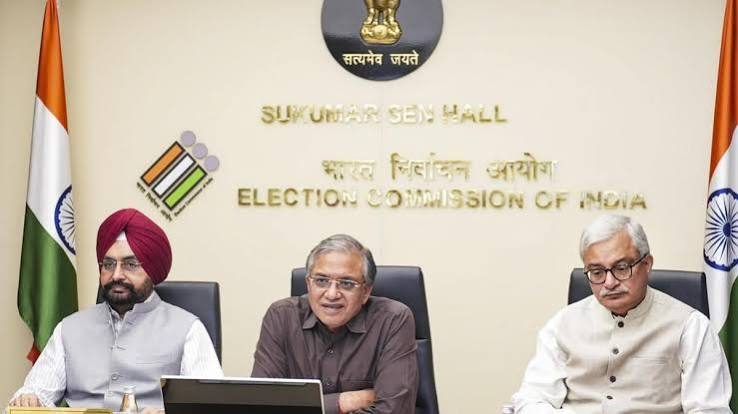
The Election Commission of India has issued a detailed clarification regarding the decentralised nature of its ECINet platform and the legality of voter registration processes, addressing recent concerns about data centralisation and additional declarations for new voters.
ECINet is a decentralised platform where only designated election officials can perform statutory functions, not headquarters staff. Concerns were raised by Election Commissioners about the 'gradual centralisation' of the electoral roll database.
Cybersecurity for the ECINet platform is centrally managed to protect it from malicious attacks.
The Election Commission defended the legality of an additional declaration sought from new voters during the Special Intensive Revision (SIR).
A Supreme Court judgment upheld the SIR exercise as consistent with the Representation of the People Act and the Constitution.
The Election Commission's ECINet is a 'decentralised' platform where statutory functions can only be performed by the designated election officials and not by anyone at the poll body's headquarters, EC officials said on Thursday, citing official documents.
The assertion comes amid questions over the functioning of the EC's digital systems following a section of media reported that Election Commissioners Sukhbir Singh Sandhu and Vivek Joshi had raised concerns over the 'gradual centralisation' of the electoral roll database and the access available to officials in states.
Understanding ECINet's Decentralised Operations
The officials said booth level officers (BLOs), assistant electoral registration officers (AEROs), electoral registration officers (EROs), district election officers (DEOs) and chief electoral officers (CEOs) perform their respective statutory functions on ECINet using unique IDs and passwords.
"No one else can perform their statutory function on ECINet, including any other officer of the ECI," an official said.
Cybersecurity for the platform is, however, provided centrally by the EC.
Officials said this was necessary to protect it from malicious attacks, citing around 68 lakh such attempts on counting day during the assembly elections earlier this year.
Integration Of ERONET And Cybersecurity Measures
ERONET, the EC's earlier electoral roll management system, has now been integrated into the broader ECINet platform.
Official documents refer to it as the 'Electoral Roll module of ECINET Portal (previously ERONET)'.
The issue has come into focus following reports that EROs in Goa found 97 voters eligible during the Special Intensive Revision (SIR) but were unable to restore their names as the software did not provide a rollback option.
Addressing Electoral Roll Revision Challenges
Separately, EC officials also rejected questions over the legality of an additional declaration sought from new voters along with Form 6 during the SIR.
Citing official documents, they said the declaration requirement was part of the June 24, 2025 Bihar SIR order and had the unanimous approval of the Commission.
The same provision was included in subsequent SIR orders covering 12 states and Union Territories in October 2025, and 19 states and UTs in May 2026, again with unanimous approval.
The officials maintained that Form 6 itself was not amended and that an additional declaration was sought along with it.
Legality Of Additional Voter Declarations Upheld
The clarification follows the newspaper report saying Joshi had recorded that Form 6 could not be changed through SIR instructions without amending the Registration of Electors Rules, 1960, a view with which Sandhu concurred.
Sandhu subsequently described the reported change as 'unauthorised and illegal'.
The EC officials also cited a May 27 Supreme Court judgment which held that the SIR exercise did not conflict with the Representation of the People Act or the 1960 Rules and was traceable to Section 21(3) of the Act read with Article 324 of the Constitution.