
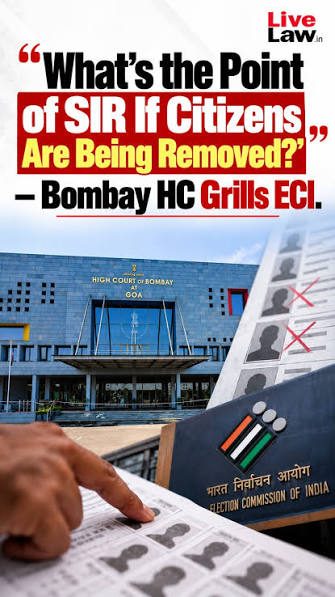
New Delhi : The Election Commission of India has clarified to the Bombay High Court that a voter's name missing from the draft Special Intensive Revision (SIR) roll does not automatically mean it has been deleted, as the court reserves its verdict on a crucial writ petition from a Goa resident.
The ECI informed the Bombay high court on Tuesday that absence from a draft Special Intensive Revision (SIR) roll does not mean a voter's name has been deleted.
SIR is a comprehensive, 'de novo' exercise to prepare the electoral roll afresh from the ground up, unlike a Special Summary Revision (SSR) which only updates an existing roll.
A Goa resident's family filed a writ petition after their names were missing from the SIR roll, prompting the ECI's clarification.
The ECI argued that the petitioner had not resided at the old address for eight to ten years and did not apply to change it before the SIR process began.
The petitioner's application to change address via Form 8 was rejected on January 21, 2026, after the draft roll was published on December 16, 2025, and the objection deadline passed on January 19.
The absence of a voter's name from the draft special intensive revision (SIR) roll does not mean that it has been deleted, the Election Commission of India (ECI) told the Bombay high court in Panaji on Tuesday, as the court reserved its verdict on a writ petition filed by a Goa resident.
Understanding Special Intensive Revision
A special intensive revision is a fresh preparation of the electoral roll and not a Special Summary Revision (SSR) where the roll is only updated, ECI lawyer Senior Advocate Ashutosh Kumbhakoni told the Goa bench of the High Court.
After the arguments concluded, the bench of Justices Valmiki Menezes and Amit Jamsandekar reserved their judgement. The petition was heard amid a raging controversy over the SIR and functioning of the ECI.
Six members of Paresh Salgaonkar's family, residents of St Cruz constituency in North Goa district, had filed the writ petition claiming that their names were deleted from the electoral roll during the SIR.
Petitioner's Case Against ECI
An SIR is a comprehensive, 'de novo' exercise as the electoral roll must be 'prepared afresh from the ground up', while a special summery revision updates an existing roll, the lawyer said.
"Absence from the draft SIR roll does not automatically amount to deletion," said Advocate Kumbhakoni.
As the roll is being prepared afresh, a name missing from the draft roll has not technically been 'deleted', he said.
"The summary revision updates the existing electoral roll based on information received through the prescribed procedure while SIR rebuilds the electoral roll through an intensive process based on the enumeration exercise," Advocate Kumbhakoni stated.
ECI's Stance On Voter Address Changes
"According to the submission, the petitioner had not been residing at the address shown in the pre-SIR electoral rolls for eight to ten years," the ECI lawyer said, and argued that the petitioner also did not apply to change his address, which should have been done before the SIR process began.
"In fact, my lord, this is a classical case which shows the effectiveness of SIR," Advocate Kumbhakoni said.
The judges noted that they had made it clear right from the beginning that 'there is no challenge to the SIR process' itself.
Timeline Of Petitioner's Application
Advocate Vivek Rodrigues, representing the petitioner, said that the enumeration began on November 4, 2025, after which the Booth Level Officer (BLO) visited both the old and new addresses of the petitioner on November 8, 2025.
On November 12, the petitioner contacted the BLO and requested that the enumeration form be given. But the BLO refused, as the 'same must be delivered at the address recorded in the electoral roll (which was the old address)'.
The petitioner later filled Form 8 to change the address. The ECI informed on December 8, 2025, that the application for change of address had been received, but when the draft roll was published on December 16, the petitioner's name was missing, the lawyer said.
The BLO told the petitioner that the Form 8 was still under process and had not been rejected.
Subsequently, on January 17, 2026, the petitioner received a letter from the ECI that his application had been forwarded to the Electoral Registration Officer (ERO). January 19 was the last date to file objections to the draft roll.
"On January 21, my application is rejected. So I am neither in the boat nor in the canoe, left in the sea," Advocate Rodrigues argued.