
Hyderabad: The retro hair, the vintage clothing, that's not the real charm of these images. It's the ability to look at a screen and create the one thing modern technology has never been able to give us: The tactile, imperfect feeling of memory, points out Kaleem Ullah Fasihi.
To call this just a 'AI trend' is to miss the real story. It is a measure of our freedom in time.
In an age where every single moment of life is instantly captured, flawlessly optimised and endlessly shared, our favourite feature of the technology of the future is its reverse gear.
In India, users are recreating vintage Bollywood imagery, regional studio portraits and detailed 1980s wedding photographs.
If you've been scrolling through Instagram or X at all since early September, you may have noticed a curious change in the space-time continuum.
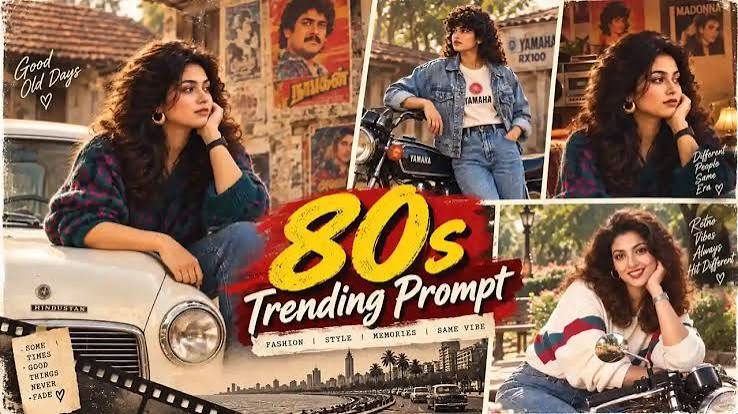
Your friends, colleagues and cousins are suddenly sporting voluminous hair and thick mustaches, dressed in blue denim jackets, golden chains around their necks and a suspiciously deep love of analog film grain.
They look like they were ripped out of a family album from 1985. No, thrift stores haven't suddenly experienced a boom in sales. What you're seeing is the viral ChatGPT '80s photo trend -- and it's likely the most fascinating digital phenomenon of the year.
At first, it's easy to write this off as just another social media filter. We have been here before, after all. Over the past few years our timelines have been regularly stuffed with algorithmic dress-up.
We watched as everyone transformed into wide-eyed Studio Ghibli anime characters, and not long after, we suffered through the '90s Yearbook trend where suddenly everyone looked like an extra from Clueless (1995).
But this '80s trend is different. People aren't just trying to make their modern photographs look old anymore.
They are employing generative artificial intelligence to envision themselves as completely different people, in a completely different time.
It is this very difference that has allowed this trend to go so fast, and that has held up a mirror to our deeply complicated relationship with modern technology.
Nostalgia has always been the internet's most dependable currency. Old songs, forgotten TV shows, vintage fashion are endlessly rehashed.
Yet generative AI adds something new to the nostalgic experience: personal agency.
You get to be right in the middle of it instead of just watching someone else's recreation of the past.
Traditional filters work by imposing a predetermined visual effect -- a sepia tone, a fake light leak -- on an existing image.
AI image generation is far more advanced. It radically redefines the costume, the setting, the illumination, the photographic composition, and yet maintains the essential identity of the subject.
The user is asking a different basic question. We have no more questions like, 'What if I had a '80s filter on my selfie?' What we are asking is, 'What would a photograph of me in the 1980s actually have looked like?'
That is when the trend rapidly moved from mere nostalgia to something more deeply cultural. Of course, the '80s were not the same across the board.
Some users ask the AI for neon and denim in the style of Hollywood; others are recreating very specific regional memories.
For example, the trend has become a way to explore localised visual histories in India.
We're witnessing re-creations of the dramatic, warm lighting of vintage Bollywood, worn-out portraits emulating old-school regional photography studios, and extremely detailed 1980s wedding portraits, complete with era-specific traditional attire.
This is where the phenomenon goes from a fun digital parlor trick to a deeper psychological illusion.
Why Fake Memories Feel So Familiar
Many of those generated images show events that never took place. The person in the picture has never owned those clothes. Never stood in that studio.
Most of the time, the person jumping on the trend wasn't even born in the '80s. But these images are surprisingly familiar.
It's an exact replica of the slightly faded portraits of our parents and grandparents that sit quietly in our family homes in our physical photo albums.
We are facing a collective anemoia -- a significant, heartfelt yearning for a period we did not actually inhabit. AI is creating something that looks like a memory, without any real experience having occurred.
It begs an interesting question: What is it that we find so attractive about the visual language of a decade ago?
The answer is in our current obsession with digital perfection, and our quiet fatigue with it. Today photography is based on sheer clarity.
Our phone cameras are ultra sharp, our images live on cloud servers in perfect high-def, and any blemish can be edited away with a few touches on screen.
Still, the AI '80s esthetic intentionally includes flaws. People want film grain on purpose and commanding ChatGPT for the same.
They're requesting a soft focus. They want discolored images, uneven lighting, and a little blur of a slow shutter speed.
We are asking the most advanced, computerised and flawless technology ever created by human to simulate human imperfection.
Ironically, the very things that were technical constraints of 1980s cameras have become highly coveted visual characteristics.
A photo that appears a little damaged holds more emotional importance than a digitally satisfactory file.
It's a quiet but but brutal rejection of the visual perfection that the digital age has forced on us.
To call this just a 'AI trend' is to miss the real story. It is a measure of our freedom in time. In an age where every single moment of life is instantly captured, flawlessly optimised and endlessly shared, our favourite feature of the technology of the future is its reverse gear.
The retro hair, the vintage clothing, that's not the real charm of these images.
It's the ability to look at a screen and create the one thing modern technology has never been able to give us: The tactile, imperfect feeling of memory.